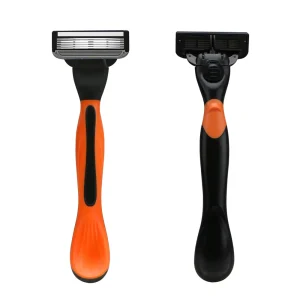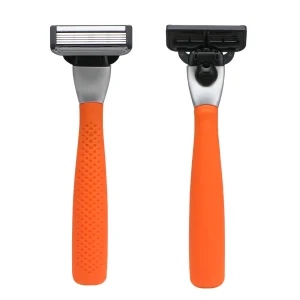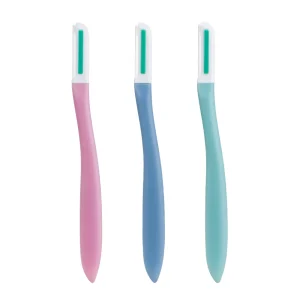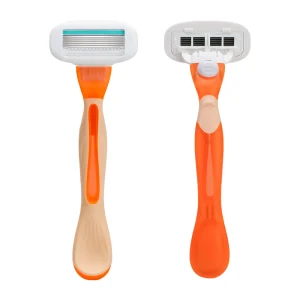

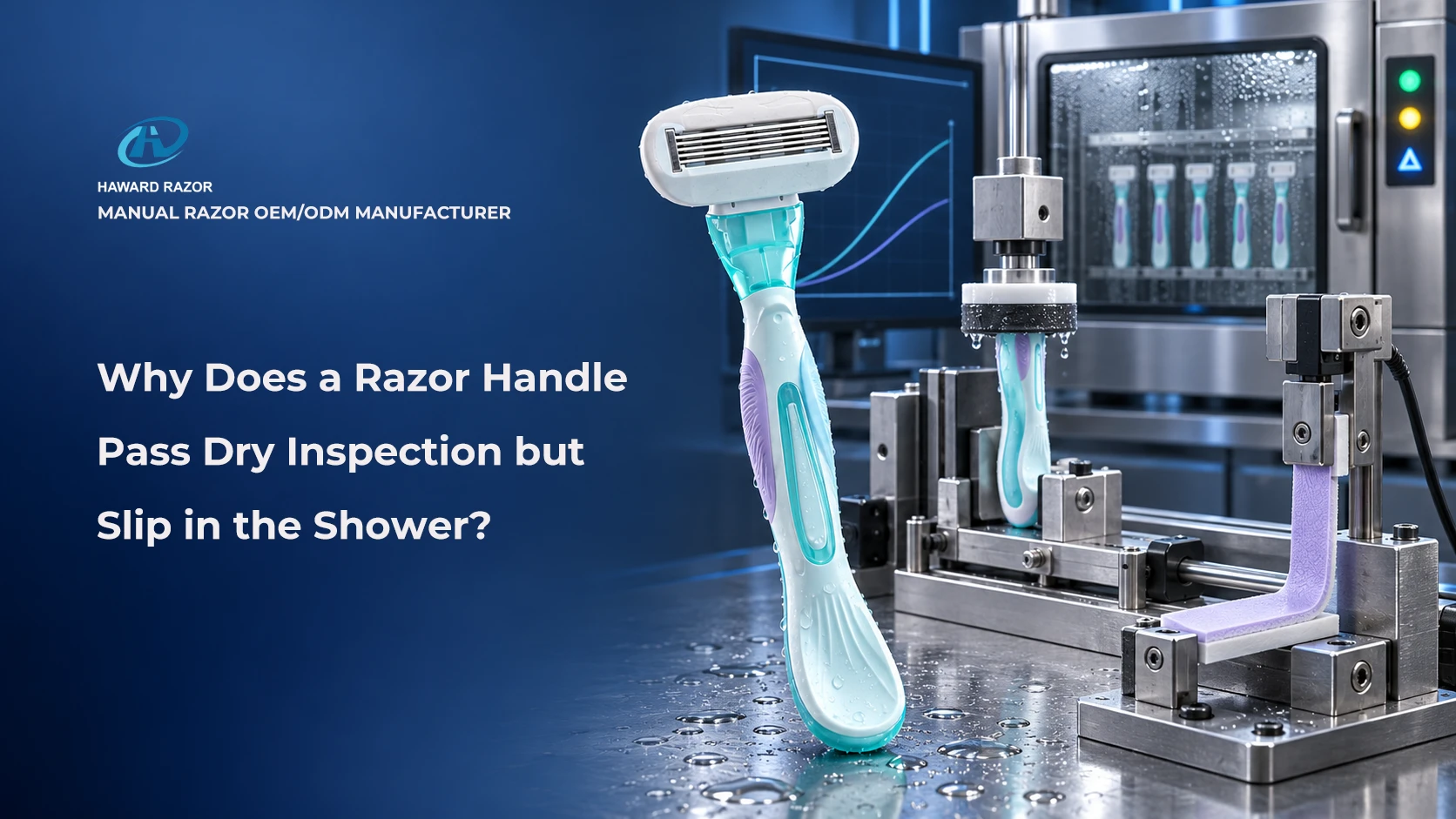
A handle can feel secure when dry and still rotate in a wet hand. Water lowers interfacial friction; soap adds lubrication; mold texture varies by cavity; and weak TPR bonding may lift after drying. The first complaint may arrive after launch, when the brand is facing returns, rework, and a tooling debate with its Supplier. The problem becomes harder because “non-slip” is often approved by touch, without a defined normal force, contaminant, pull direction, or aging history. That leaves product designers and QA teams unable to separate material failure from geometry or test variation. A robust razor wet grip test prevents this gap by linking friction, torque-to-slip, TPR overmold adhesion, surface texture, and environmental aging to a drawing-controlled validation plan.
The best validation method combines dry, water-wet, and soap-contaminated slip testing; 90° peel or drawing-specific assembly adhesion; Shore hardness; and post-aging retesting under controlled load, speed, pad, and liquid conditions. Haward applies this measurement chain to Customizable OEM and ODM anti-slip handle programs; every acceptance limit remains product- and drawing-specific.
Product designers, women’s Razor buyers, and QA engineers should continue. The sections below show how to build a reproducible method, select meaningful development windows, diagnose adhesion failures, and convert laboratory results into Manufacturer process controls that survive pilot production and repeated wet use.
Define Wet Grip as a Handle System, Not a TPR Material Claim
Separate Material Friction from Geometry and User Loading
Wet handle friction is created by the complete contact system. TPR hardness and texture matter, but so do handle diameter, cross-section, finger stops, rib orientation, grip area, center of mass, and the direction in which the cartridge loads the wrist. A soft compound can still slip if water forms a continuous film. A harder compound may perform well when its ribs interrupt that film and provide mechanical purchase.
No generally adopted Razor-specific standard assigns a minimum coefficient of friction to a curved handle. Film methods such as ISO 8295 illustrate static and kinetic friction concepts, but they do not directly validate a three-dimensional overmolded handle. An OEM specification should therefore define the actual assembly, fixture, contact pad, contaminant, normal force, and motion. Useful outputs include:
- Breakaway force at the first measurable slip;
- Steady sliding force over a defined travel;
- Torque-to-rotation around the handle axis;
- Slip displacement before loss of control; and
- Wet-to-dry retention for the same sample and direction.
Use coefficient of friction only when normal and tangential forces are known and the geometry supports the calculation. Otherwise, report force or torque to avoid presenting a fixture-dependent value as a universal material property.
Build a Reproducible Razor Wet Grip Test
Control the Contact Pad, Normal Load, Speed, Direction, and Liquid Dose
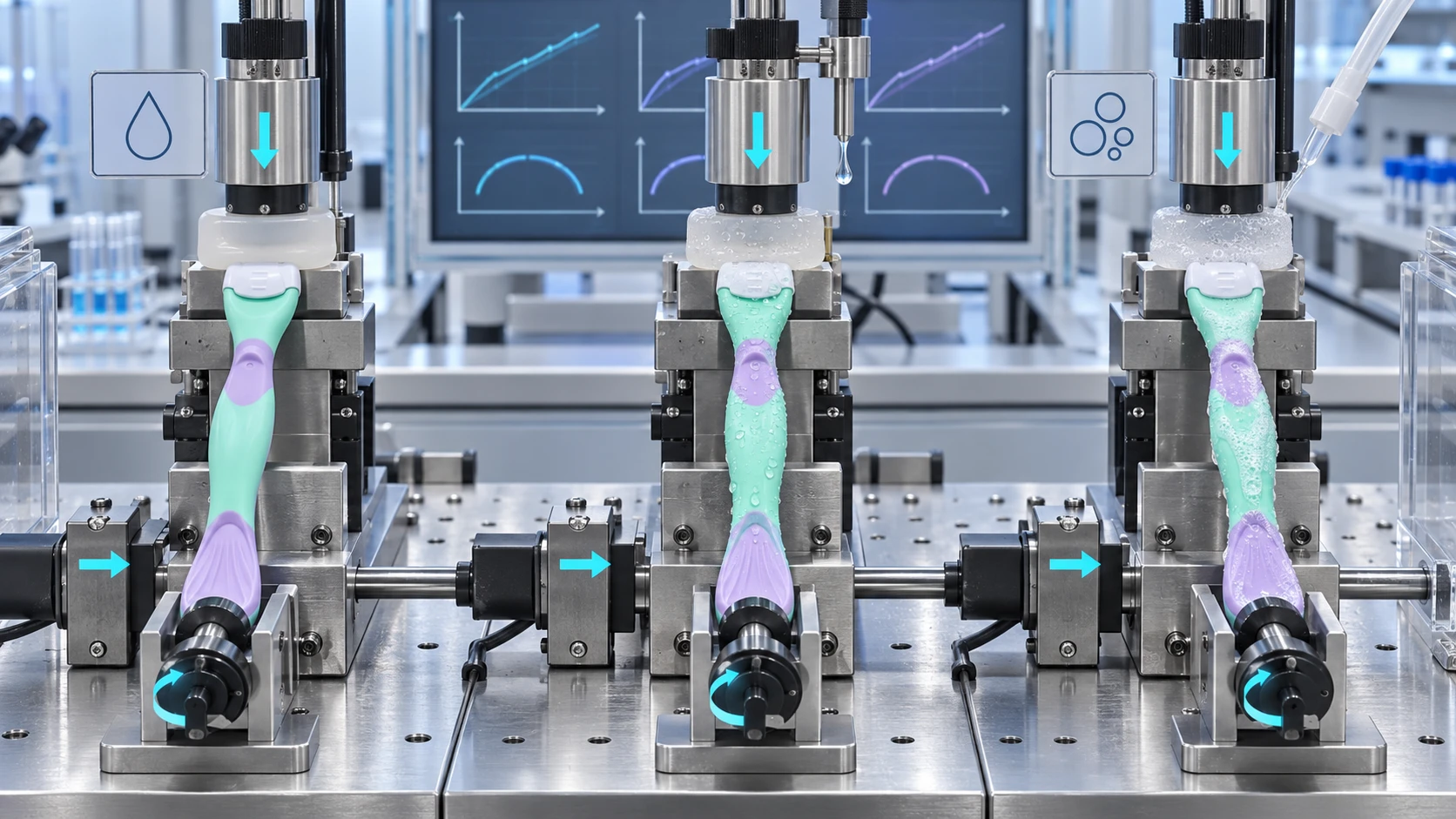
A repeatable razor wet grip test should hold the Razor by functional datums without compressing the TPR. An instrumented pad then applies a controlled normal force while the test frame pulls axially or rotates the handle. The pad must have a specified material, hardness, texture, contact area, cleaning method, and replacement interval. Changing from smooth silicone to textured rubber can change the ranking of two designs.
The following values are an illustrative development protocol, not a universal standard. A brand may begin with a 10 ± 0.5 N normal force, 100 mm/min pull rate, 1.0 ± 0.1 mL liquid dose, and 30 ± 5 second dwell. Test both axial pull and roll rotation because a women’s body Razor often slips by twisting rather than sliding straight out of the hand.
| Test Condition | Illustrative Preparation | Primary Output | Failure Risk Exposed |
|---|---|---|---|
| Dry baseline | Conditioned handle and clean pad; no liquid | Breakaway force and roll torque | Texture, geometry, or hardness mismatch |
| Water-wet | 1.0 mL water, distributed over the grip zone; 30-second dwell | Wet force and wet-to-dry retention | Hydroplaning and poor drainage |
| Soap-contaminated | 1.0 mL of buyer-defined 1% neutral surfactant or target cleanser | Minimum force, torque, and result variability | Lubrication, residue, and unstable hand control |
A buyer-defined internal index may be calculated as Wet Grip Retention = Wet Breakaway Force / Dry Breakaway Force × 100%. Report absolute force as well. A high percentage can hide a weak dry baseline.
Measure a Distribution, Not One Attractive Result
Run repeated measurements across samples, mold cavities, TPR lots, and assembly dates. Record the mean, standard deviation, minimum, and failure mode. Use separate samples when residue carryover could bias another condition. Before Supplier comparison, complete a measurement-system analysis with two operators and controlled samples. If fixture variation consumes a large portion of the proposed tolerance, improve the method before judging the Manufacturer.
Validate TPR Overmold Adhesion Independently from Grip
Use 90-Degree Peel Principles and Record the Failure Mode
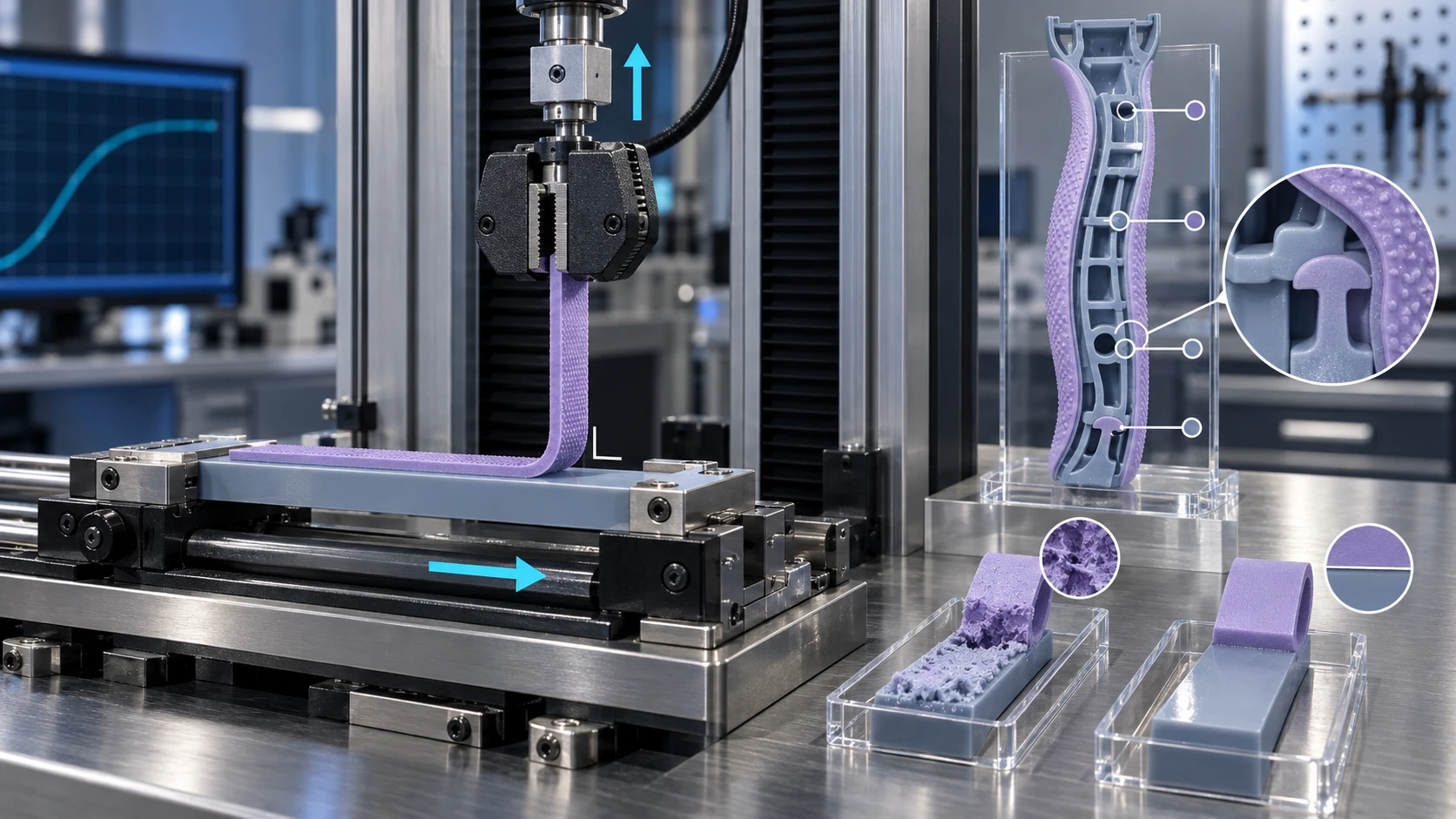
A handle may generate strong friction on day one while its overmold is already poorly bonded. TPR overmold adhesion therefore needs a separate destructive test. ISO 813:2019 defines a 90° peel method for vulcanized or thermoplastic rubber bonded to a rigid substrate. It is primarily intended for laboratory test pieces. It provides a sound reference for material selection and process comparison, but it does not automatically prescribe the acceptance limit or fixture for a finished Razor handle.
For development, mold a controlled peel tab on a witness coupon that reproduces the handle’s rigid resin, TPR grade, texture interface, and processing history. Report:
- Average peel strength in N/mm over the defined evaluation length;
- Peak peel force and force-displacement curve;
- Adhesive failure at the rigid-substrate interface;
- Cohesive failure within the TPR; and
- Mixed failure, tearing, whitening, or substrate fracture.
Add a drawing-specific finished-handle test at exposed edges, ribs, and mechanical locks. Acceptance values must be established through design validation and frozen on the approved drawing. They should never be copied from another handle with different materials or geometry.
Control the Overmolding Process That Creates the Bond
Link Adhesion Results to Material Compatibility and Molding Parameters
Strong adhesion begins before the second shot enters the mold. The rigid substrate and TPR must be chemically compatible, or the design must provide reliable mechanical interlocks. Surface contamination, excessive delay between shots, incorrect substrate temperature, material moisture, or unapproved regrind can create an apparently complete overmold with weak interfacial strength.
The OEM or ODM control plan should identify the process variables that influence cartridge-side hand control and bond durability:
- Approved rigid resin and TPR grade, color masterbatch, and lot traceability;
- Material drying requirements and maximum open-container time;
- Melt temperature, mold temperature, injection speed, and transfer timing;
- Gate condition, fill balance, holding pressure, cooling time, and cavity number;
- Permitted regrind percentage, if any, and contamination controls; and
- First-piece, restart, and post-maintenance approval records.
Use a designed experiment during tooling qualification to distinguish significant factors from assumptions. Check TPR hardness using ISO 48-4 or an agreed equivalent, but do not use Shore hardness as a substitute for adhesion. Haward’s D565 anti-slip ergonomic handle, D968W metal-and-rubber handle, and D552LW plastic-and-rubber handle illustrate why each platform needs its own material-process window.
Combine Liquid Exposure with Razor Grip Aging

Age the Material, Then Repeat Friction and Adhesion Tests
Razor grip aging is not demonstrated by heat exposure alone. The product sees water, cleanser, foam residue, warm storage, repeated drying, and mechanical flexing. ISO 188:2023 covers accelerated aging and heat-resistance tests for vulcanized and thermoplastic rubbers. ISO 1817:2026 evaluates changes caused by liquid exposure. These methods support a defensible program, but the brand must select service-relevant media and drawing-specific limits.
| Validation Stage | Illustrative Development Condition | Measurements Before and After | Typical Warning Signal |
|---|---|---|---|
| Conditioned baseline | 23 ± 2°C, 50 ± 10% RH, minimum 24 hours | Grip, peel, hardness, mass, dimensions | Initial process variation |
| Warm-water exposure | 40 ± 2°C water for 24 hours | Immediate wet grip and 24-hour recovery | Swelling, whitening, or friction loss |
| Cleanser exposure | Buyer-defined 1% surfactant at 40 ± 2°C for 24 hours | Grip, adhesion, mass change, tackiness | Plasticizer migration or interface attack |
| Heat-aging screen | 70 ± 2°C dry heat for 168 hours | Peel retention, hardness shift, cracking | Embrittlement, softening, or bond decay |
| Wet-dry cycling | 250 buyer-defined wet, drain, and dry cycles | Roll torque, edge lift, texture condition | Progressive debonding or residue buildup |
razor-grip-aging-water-soap-heat-validation.
These are screening conditions, not universal qualification limits. Retest immediately when wet and after a defined recovery period to separate temporary swelling from permanent damage. Accelerated exposure ranks materials and processes; it cannot prove a calendar service life unless the Manufacturer has established correlation with real-use aging.
Correlate Bench Data with Women’s Razor Use Cases
Test Axial Pull, Roll Rotation, and Thumb-Control Zones
A women’s Razor may be held with a power grip on the leg, a light fingertip grip near the ankle, or a rotated wrist around the knee. Soap, conditioner, and shower gel also create different boundary films. One axial pull result cannot represent all of these conditions.
Use three bench modes: axial extraction, roll torque, and a localized thumb-pad test. Then correlate the ranking with a controlled formative panel. An early study might include 12–20 representative users; the final size should follow the brand’s risk and statistical plan. Use a guarded or non-bladed prototype where appropriate. Record slips, grip repositioning, perceived security, and hand-contact location. If users and the fixture rank designs differently, inspect wrist angle and pad compliance before changing the TPR. This makes the razor wet grip test relevant to product ergonomics.
Convert Validation into OEM and ODM Production Controls
Sample by Cavity, Lot, Shift, and Process Change
A Supplier should not qualify one ideal laboratory sample and then rely only on visual inspection. During pilot production, a practical starting plan is at least 30 finished handles distributed across all active cavities and three production lots, subject to buyer risk review. The team should use those data to establish the drawing limits, sampling frequency, and reaction plan.
- Incoming control: verify resin identity, TPR lot, color master, and applicable material certificates.
- First-article audit: check critical dimensions, texture, hardness, wet grip, and destructive adhesion.
- In-process audit: trend cavity-level weight, molding parameters, surface defects, and scheduled destructive samples.
- Periodic validation: repeat water, soap, and aging screens at the agreed interval.
- Change authorization: revalidate after material, colorant, mold texture, gate, equipment, cavity, or process-window changes.
Freeze the approved test method, fixture drawing, pad specification, liquid recipe, data template, and golden samples. An ISO/IEC 17025-competent external laboratory can strengthen independent results when contractually required, but the Razor method itself still needs buyer approval. Raw curves and failure photographs should remain traceable to the production lot.
Use Failure Signatures to Correct the Right Cause
Low dry and wet force points to geometry, contact area, or surface selection. Strong dry performance with severe soap loss suggests poor drainage or excessive smoothness. Normal grip with edge lift indicates an adhesion problem. Hardness drift after heat aging suggests compound instability. Cavity-specific failures indicate fill balance, temperature, or contamination. Do not automatically select a softer TPR: it may attract residue or tear at thin ribs. Compare friction curves, peel data, cross-sections, cavity history, material lots, and aging observations before correcting the mechanism.
Specify Wet Grip Before Freezing the Handle Design
Send Haward your handle geometry, target user, TPR and substrate requirements, cleanser exposure, and life-cycle expectations. We can develop a Customizable razor wet grip test, adhesion plan, and razor grip aging matrix for your OEM or ODM program. Contact us to review your drawing and validation scope.