





A Supplier may quote a monthly output, win the program, and still miss the first delivery. The headline multiplies machine speed by every available hour while ignoring mold cavities, changeovers, downtime, rejected parts, labor gaps, shared lines, and orders from other customers. When the peak order arrives, molded handles accumulate before cartridge assembly, finished Razors wait for printed cards, or packing becomes the hidden constraint. The buyer then faces partial shipments, airfreight, retailer penalties, and lost shelf space. This is the real danger behind unverified razor factory capacity. A disciplined due-diligence review prevents it by tracing one approved SKU through molding, assembly, inspection, and packing, then comparing demonstrated good output with the capacity available during the required production window.
A qualified Supplier proves model-specific output with active mold cavities, actual cycle time, uptime, yield, changeover loss, staffing, line allocation, and committed load. Haward evaluates Customizable OEM and ODM Razor programs across molding, cartridge assembly, inspection, and packing instead of presenting one unsupported monthly-capacity figure.
Sourcing directors, operations managers, large retailers, and engineering wholesalers should continue. The following sections reveal the factory-floor checks experienced buyers use to expose inflated capacity claims, locate the real razor production bottleneck, distinguish theoretical from available output, and contract for a delivery plan that can survive seasonal demand peaks.
Replace One Capacity Number with Four Commercially Different Numbers
Ask What the Supplier Means Before Comparing Quotations
Two factories can both claim “three million units per month” while offering very different delivery security. The first may describe all equipment at ideal speed. The second may report saleable units already demonstrated on the exact Razor and package. A sourcing team should require four definitions:
- Installed capacity: all listed equipment, whether or not the correct tooling, operators, and materials are available.
- Theoretical capacity: calculated output at nominal cycle time, usually before downtime, scrap, and changeovers.
- Demonstrated capacity: good units recorded over a representative period on the relevant product family.
- Available capacity: demonstrated output minus confirmed orders, maintenance, reserved flexibility, and other committed load.
The last figure matters most to a buyer. It must be linked to a named SKU, shift pattern, packaging specification, calendar window, and facility. An OEM Manufacturer that cannot separate these definitions has not yet substantiated its razor factory capacity. Require the assumptions in writing so sales language can be reconciled with production records during the audit.
Map the Complete Razor Routing Before Looking for the Bottleneck

Follow Good Units, Not Individual Machine Speeds
The real razor production bottleneck is the stage with the lowest sustainable good output for the specified product mix. It may not be the most expensive machine. Begin with a routing that shows every transformation and inspection point for the selected Razor:
- Mold rigid handle, cartridge housing, guard, cap, and connector components.
- Overmold soft-grip areas or complete secondary decoration where required.
- Prepare blades, spacers, lubricating strips, and other cartridge inputs.
- Assemble or stake the cartridge and perform functional inspection.
- Join the cartridge and handle, or pack replacement heads separately.
- Load the retail pack, seal it, verify artwork and barcode, carton, and palletize.
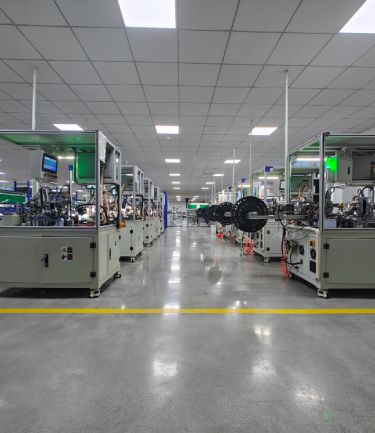
Record cycle time, batch size, queue, work-in-process limit, yield, and staffing at each step. A pile of molded handles before assembly signals imbalance; finished Razors waiting beside an idle blister line expose packing dependence. Capacity is therefore a value-stream result, not a machine inventory. The Supplier should also identify outsourced operations because subcontracting introduces visibility risk, extra transport time, and another capacity owner.
| Process Stage | Capacity Drivers to Verify | Evidence Requested | Typical Hidden Risk |
|---|---|---|---|
| Injection molding | Active cavities, cycle time, compatible presses, uptime, resin and color changes | Mold card, machine log, cavity output, downtime and scrap report | Blocked cavity or single-machine dependence |
| Cartridge assembly | Station rate, blade feeding, staking or welding, micro-stops, change parts | Hourly production board, stoppage codes, good-count history | Nameplate-speed inflation |
| Final assembly and inspection | Operator balance, functional checks, rework, shift coverage | Standard work, labor roster, inspection and rework records | Labor-constrained output |
| Retail packing | Pack style, sealing cycle, artwork change, barcode control, carton rate | Pack-line trial, approved artwork, hourly packed-good count | Late packaging or manual-loading bottleneck |
Verify Injection Molding Capacity at the Mold-and-SKU Level
Count Active Cavities and Real Cycles, Not Machines on a Tour
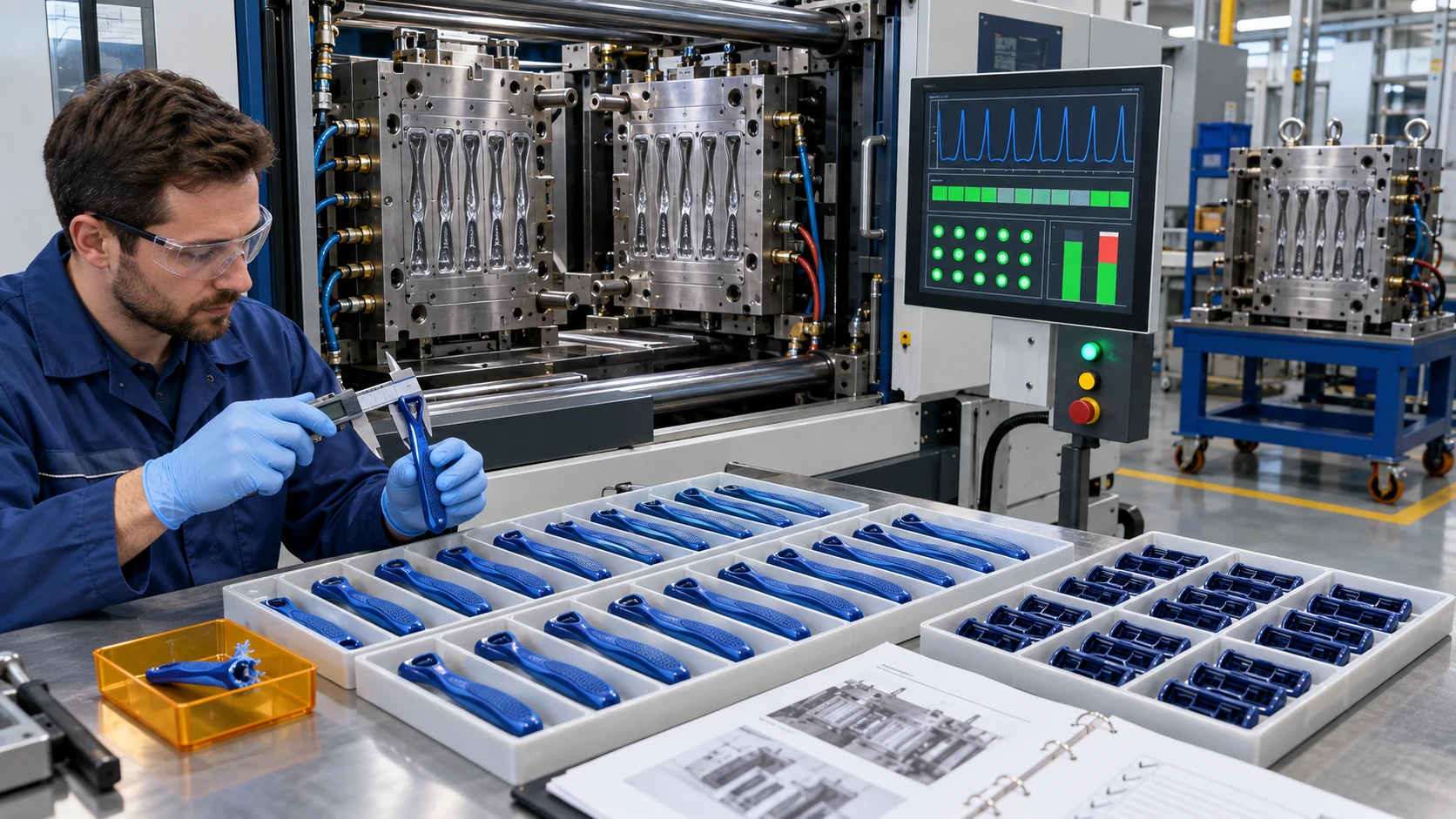
Injection molding capacity begins with the approved tool, not the number of presses in the workshop. Verify the designed cavity count and the cavities actually producing conforming parts. A nominal eight-cavity mold running with one cavity blocked is a seven-cavity asset. Confirm that alternative presses have the correct clamp force, shot size, controls, robot interface, and validated process window; an empty press is not automatically backup capacity.
Use a transparent calculation:
Good units per hour = active cavities × 3,600 ÷ actual cycle seconds × operating uptime × first-pass yield.
- Time at least 30 consecutive stable cycles, not one best cycle.
- Separate planned color or mold changes from unplanned breakdowns.
- Include resin drying, purge, startup scrap, insert loading, and TPR overmolding.
- Review output and defects by cavity because one weak cavity can reduce saleable output.
- Check spare inserts, preventive maintenance, hot-runner support, and mold-repair lead time.
Injection molding is a multistage process whose cycle includes filling, cooling, and reset activities. The buyer should therefore use live and historical cycles, not a drawing estimate, when validating OEM or ODM capacity.
Test Razor Assembly Line Capacity Under Normal Production Conditions
Observe Stops, Product Mix, and Inspection Load
A high-speed line rarely delivers its rated speed for an entire shift. Razor assembly line capacity is reduced by material replenishment, blade-feed jams, strip placement, welding or staking alarms, change-part adjustments, inspection, breaks, and fault recovery. Ask the Manufacturer to run the target blade count and cartridge construction with normal staffing, approved components, and routine quality checks. A demonstration using an easier product does not validate the buyer’s program.
During the trial, record:
- Scheduled time, planned downtime, run time, and unplanned stop minutes;
- Total assemblies, conforming assemblies, rework, and scrap;
- Average speed while running and total good units per scheduled hour;
- Number, duration, and reason code for every stoppage;
- Operators needed at feeding, inspection, unloading, and material handling;
- Changeover time between 3-, 5-, or 6-blade platforms where relevant.
Compare the live trial with eight to twelve weeks of production history. A short trial can hide maintenance and staffing losses; history can hide recent deterioration. Both views are necessary to establish credible razor factory capacity.
Treat Packing as a Production Process, Not an Administrative Finish
Custom Retail Packs Often Become the Last and Tightest Constraint
A Supplier may have spare molding and assembly hours yet miss delivery because the Customizable package is slow. Bulk Razors, paper cards, blister packs, flow wraps, refill boxes, gift sets, and display cartons require different equipment and labor. Manual loading may be acceptable for a pilot order but becomes a scalability risk during a national promotion.
The buyer should perform a line trial using production-intent packaging. Measure good retail packs per scheduled hour and verify:
- Printed-material arrival and approved artwork revision;
- Feeding orientation and the number of manual touches per pack;
- Sealing speed, seal inspection, barcode verification, and label application;
- Pack-count, inner-box, master-carton, case-label, and pallet requirements;
- Changeover loss between languages, colors, customers, and promotional inserts;
- Finished-goods inspection, quarantine, and release time.
Do not convert unpacked Razor inventory into “finished capacity.” Until the correct saleable package passes inspection, it cannot satisfy the retailer’s purchase order. Packing performance must therefore appear in the same capacity model as molding and assembly.
Recalculate Capacity with Uptime, Yield, and Changeover Loss
Use an Illustrated Buyer Model to Identify the Constraint
The following figures are a buyer-defined example, not Haward production claims or universal acceptance limits. They show why theoretical output is commercially misleading. Each stage starts with output possible during scheduled time, then applies measured uptime and first-pass yield. Packing becomes the constraint even though the factory owns faster upstream equipment.
| Stage | Theoretical Units per Day | Observed Uptime | First-Pass Yield | Calculated Good Units per Day |
|---|---|---|---|---|
| Injection molding | 17,400 | 82% | 98.0% | 13,983 |
| Cartridge assembly | 15,000 | 85% | 97.0% | 12,368 |
| Final assembly and inspection | 14,000 | 88% | 98.5% | 12,135 |
| Packing | 11,500 | 80% | 99.0% | 9,108 |

At 26 operating days, the line supports about 236,808 packed units per month, subject to the assumptions. If 150,000 units are already committed and 20,000 are reserved for recovery, only 66,808 units remain available. This is the capacity a procurement team can negotiate—not the 452,400 molded-unit headline obtained by multiplying 17,400 by 26 days.
Measure Changeover Loss and Product-Mix Capacity Separately
A Mixed OEM Schedule Cannot Run at Single-SKU Speed
Capacity falls as variety rises. A factory producing one standard Razor for a full month may show excellent output, while an OEM calendar containing six colors, three handle decorations, two cartridge counts, and four language packs loses hours to changeovers and approvals. Faster setup releases capacity and supports smaller economical batches, but the loss must first be measured.
Request a changeover matrix covering:
- Mold, color, resin, and TPR changes;
- Blade-count or cartridge-platform conversion;
- Logo-printing, foil, pad, or laser-decoration setup;
- Retail-pack tooling, artwork, barcode, and carton changes;
- First-off approval and startup-scrap clearance.
The schedule should show the all-wheel-stop time, approval time, and first conforming unit—not merely mechanical tool exchange. Ask the Supplier to model the buyer’s real weekly mix and campaign sizes. Consolidating compatible variants on a shared platform can protect output, while frequent short runs may move the razor production bottleneck from equipment speed to setup availability. Any proposed minimum batch should be supported by this loss model rather than sales preference.
Audit Demonstrated Output, Uptime, and Labor Dependence
Triangulate Records Instead of Accepting a Prepared Dashboard
A credible due-diligence review reconciles at least three data sources. Compare ERP or production-order completions, line counters or shift boards, and warehouse receipts for the same dates and SKU family. Investigate gaps caused by rework, delayed entry, outsourced work, or material held in quarantine. The ISO 22400 framework is useful for structuring manufacturing KPIs, but the contract must still define each formula, time base, and data source.
- Desk review: examine twelve weeks of output, downtime, scrap, changeover, staffing, and existing load.
- Site audit: walk the complete routing, verify asset identity, and observe a representative production window.
- Pilot-production audit: run the approved Razor, components, packaging, and normal quality plan.
- Peak-readiness audit: confirm materials, operators, preventive maintenance, and capacity reservation before the frozen window.
- Post-launch review: compare planned and actual output, then close recovery actions.
Downtime deserves particular attention because equipment condition directly affects available output. NIST manufacturing research likewise treats unplanned downtime as a source of lost productivity and reliability risk. Verify the maintenance schedule, critical spares, escalation response, and backup-tool readiness.
Do Not Confuse Certificates or AQL Reports with Capacity Proof
Use Compliance Documents for Their Intended Purpose
A valid ISO 9001 certificate can support confidence that the Manufacturer operates a quality management system within its stated scope. It does not certify a particular monthly output, a specific Razor, or delivery performance. Confirm the applicable edition, certificate issuer, accreditation, site address, scope, expiry or transition status, and whether the production location is covered. Then audit capacity with operational evidence.
Likewise, ISO 2859-1:2026 provides acceptance-sampling schemes indexed by an acceptance quality limit for lot-by-lot inspection. An AQL result helps decide whether an inspected lot is accepted under the agreed plan; it does not prove process capability or spare capacity. Buyers should keep these decisions separate:
- QMS evidence: are processes controlled and responsibilities defined?
- Product validation: does the approved OEM or ODM Razor meet its specification?
- Lot acceptance: does the shipment pass the agreed inspection plan?
- Capacity verification: can the complete route sustain good output within the required window?
This separation prevents certificate overreliance and keeps commercial decisions tied to the correct evidence.
Convert the Audit into Capacity Reservation and Recovery Controls
Contract for the Required Window, Not a General Factory Promise
Due diligence has limited value unless the purchase agreement preserves the verified capacity. The buyer and Supplier should translate the approved model into operational commitments. Distinguish a non-binding forecast from a firm purchase commitment, and specify when materials, labor, tooling, and line time become reserved.
- Capacity reservation: named units per week for the defined Razor and package.
- Frozen window: period in which quantity, artwork, and specification cannot change without impact approval.
- Flex band: buyer-defined upward and downward tolerance with notice periods.
- Load disclosure: regular confirmation of committed demand against demonstrated capacity.
- Recovery plan: trigger, containment, overtime rules, alternate equipment, backlog sequence, and reporting cadence.
- Subcontracting control: prior written approval and equivalent quality, traceability, and audit rights.
Define how expedited freight, missed retail windows, buyer changes, force majeure, and Supplier-caused delays are handled under applicable law. A realistic recovery plan protects supply better than an unsupported promise to “add another shift,” especially when the bottleneck requires trained labor, approved tooling, or custom packaging.
Buy Demonstrated Output, Not a Headline Number
Choose a Manufacturer that can prove razor factory capacity from molding through packed goods. Send Haward your Razor specification, forecast, launch window, SKU mix, and packaging plan to review a Customizable OEM or ODM capacity model, identify the real constraint, and build a practical production and recovery proposal.