







An importer fills a container with its bestselling disposable Razor, then discovers that system refills and facial razors will run out before the next arrival. The shipment looks efficient on a freight spreadsheet, but the warehouse receives excess stock in one category and shortages in others. Adding more SKUs can solve that imbalance, provided the cartons fit, the products are ready together, and receiving teams can identify each shipment line. Without those checks, consolidation can create extra handling or delay an urgent replenishment. Effective razor container loading starts with the assortment needed at destination, then works through carton dimensions, weight distribution, identification, and unloading. The result is a shipment that supports both transport efficiency and availability across the product range.
A qualified Supplier should provide verified carton dimensions and weights, SKU quantities, readiness dates, a feasible loading plan, and traceable shipping records. For Haward OEM and ODM programs, effective razor container loading connects Customizable assortments with inventory needs, cargo protection, and the buyer’s receiving requirements.
Importers, distributors, and engineering wholesalers can use the following guide to evaluate consolidation beyond the freight quote. We will examine the planning details experienced export teams check before booking: which products belong together, how cartons consume space, and when a simpler shipment offers better commercial value for the receiving warehouse.
Build the Shipment Around Demand at Arrival
Convert the Sales Plan into Carton Quantities
A mixed SKU container carries several product references in one container. It can still move as a full container load (FCL); the number of SKUs does not determine whether a shipment is FCL or LCL. Keep that distinction clear when requesting freight quotations.
Start with projected usable inventory when the goods become available for sale. For each disposable, system, or facial Razor SKU, compare expected demand with existing stock and confirmed inbound shipments. Then calculate the replenishment needed for the agreed coverage period and buffer.
- Demand: separate normal sales from confirmed promotional requirements.
- Inventory: exclude quarantined, damaged, or unavailable stock.
- Timing: include transit, clearance, receiving, and inspection time.
- Rounding: convert the required retail packs into complete export cartons.
The Manufacturer should receive quantities by exact SKU, including color and packaging version. For a Customizable OEM range, this prevents a healthy category total from concealing a shortage of the particular variant customers ordered.
Measure the Packed Cartons Before Comparing Loads
Give Every SKU Its Own Shipping Data
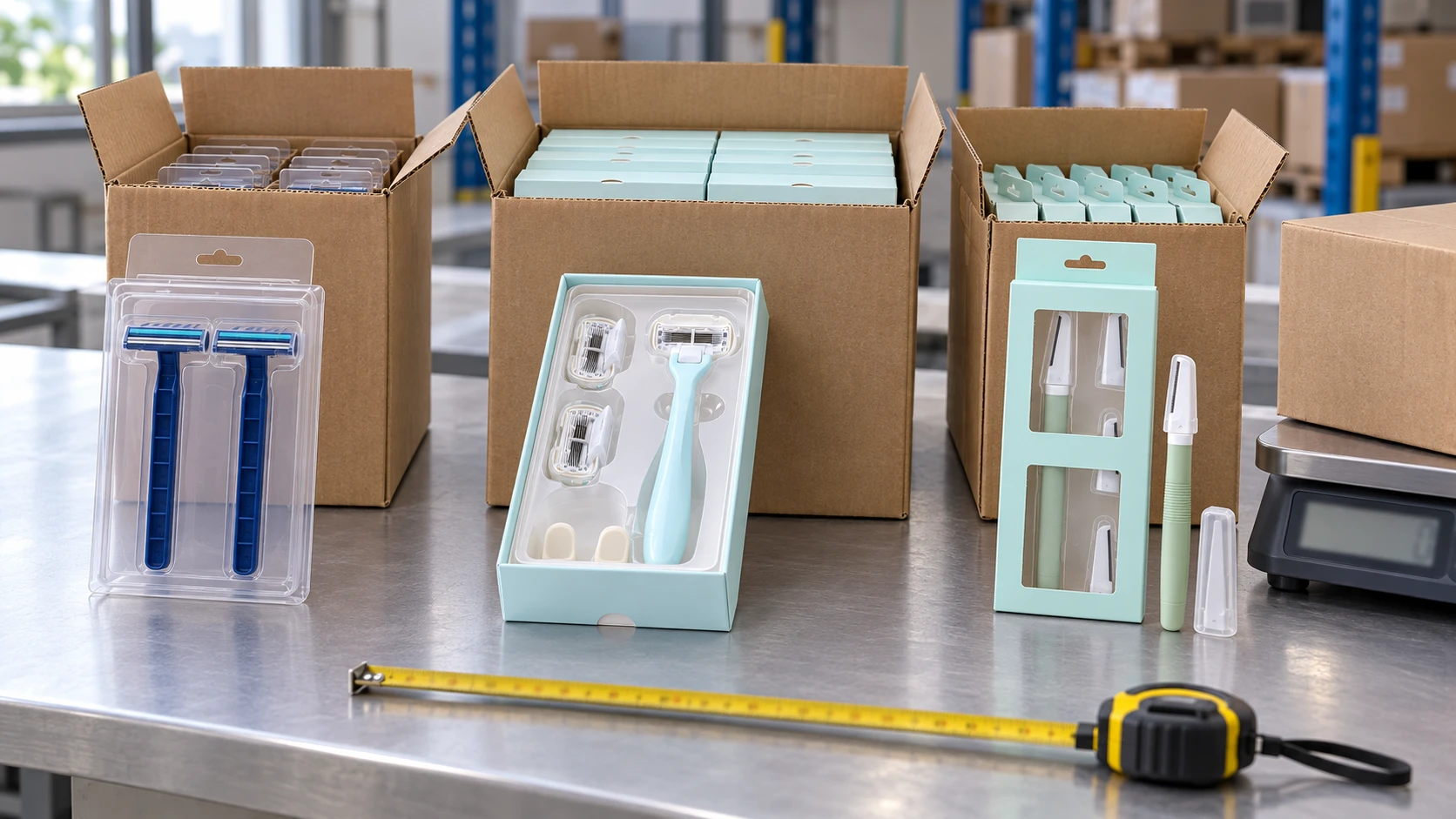
Razor export carton planning needs external dimensions of closed, packed cartons and their gross weights. Retail-pack dimensions alone do not capture dividers, protective material, carton walls, or packing clearance.
The following figures are illustrative planning inputs, not Haward catalog specifications. Each product family represents one SKU. Quantities are retail packs, not individual razors or blades.
| SKU | Outer Carton, L × W × H | Retail Packs per Carton | Carton Cube | Gross Weight | Mixed-Load Cartons |
|---|---|---|---|---|---|
| Disposable Razor multipack | 60 × 40 × 40 cm | 120 | 0.096 m³ | 8 kg | 300 |
| System Razor starter pack | 40 × 30 × 30 cm | 48 | 0.036 m³ | 6 kg | 500 |
| Facial Razor pack | 50 × 40 × 30 cm | 100 | 0.060 m³ | 5 kg | 200 |
Carton cube = length × width × height in meters. Multiplying by carton quantity gives 28.8 m³, 18.0 m³, and 12.0 m³, respectively. The combined shipment contains 1,100 cartons totaling 58.8 m³ and 6,400 kg before additional loading materials.
Ask the Supplier to reconfirm these inputs after packaging approval. A Customizable display card or gift-box revision can change the entire loading calculation.
Separate Container Volume from a Feasible Loading Plan
Check Geometry, Door Access, and Payload
Hapag-Lloyd’s example 40-foot high-cube container lists 76.3 m³ of internal capacity. The carrier also notes that equipment specifications vary. Confirm the actual booked equipment, door opening, and applicable weight limits.
For the example above, 58.8 ÷ 76.3 × 100 = 77.1%. This is nominal carton-volume utilization. It does not prove that every carton fits into an executable loading pattern.
- Model permitted carton orientations and complete rows or layers.
- Include pallets, bracing, securing materials, and unavoidable voids.
- Check stack heights against carton strength and handling requirements.
- Confirm that palletized units can pass through the door opening.
- Verify payload, floor loading, and inland transport restrictions.
Lightweight Razor packs may reach their space limit before their weight limit, but that conclusion requires actual measurements. The Manufacturer and logistics planner should review a loading layout or physical trial for unfamiliar packaging. Increasing container utilization is useful only when the resulting load remains practical to secure, transport, and receive.
Compare Assortment Coverage as Well as Container Utilization
Use the Same Planning Assumptions for Both Options
Assume weekly demand of 6,000 disposable packs, 4,000 system starter packs, and 2,500 facial packs. For this simplified example, usable stock at arrival and other inbound supply are zero.
| Planning Measure | Single-SKU Candidate | Mixed-SKU Candidate |
|---|---|---|
| Carton allocation | 600 disposable | 300 disposable + 500 system + 200 facial |
| Total carton cube | 57.6 m³ | 58.8 m³ |
| Carton gross weight | 4,800 kg | 6,400 kg |
| Nominal cube utilization | 75.5% | 77.1% |
| Disposable coverage | 12 weeks | 6 weeks |
| System starter coverage | 0 weeks | 6 weeks |
| Facial Razor coverage | 0 weeks | 8 weeks |
Both candidates still require physical loading validation. The mixed option improves nominal cube utilization by only 1.6 percentage points, yet replenishes three product lines. Its main advantage here is assortment balance.
This does not establish a lower total freight cost. A complete comparison must include the additional shipments needed to serve the same demand over the same period. Nor should different retail packs be treated as identical units when comparing cost per pack.
Choose a Dedicated Load When the Commercial Case Supports It
Recognize When Simplicity Has Greater Value
Single-SKU shipments work well when one reference has enough confirmed demand to support the quantity and the destination can process it efficiently. A national promotion, a dedicated distribution center, or an established repeat-order program may justify that approach.
A mixed SKU container becomes attractive when several references need replenishment at similar times and the warehouse can receive the assortment without excessive sorting. The decision should reflect real operating conditions:
- Demand concentration: does one SKU dominate the required volume?
- Readiness alignment: will waiting for another item delay priority stock?
- Receiving capability: can the destination handle multiple references?
- Inventory exposure: will a dedicated load create excess coverage?
- Delivery requirements: are retailer appointments or order windows different?
For Haward OEM and ODM discussions, compare a mixed replenishment with a dedicated shipment before confirming the release. Consolidation should support the buyer’s sales plan. It should not require adding slow-moving colors merely to occupy the remaining space.
Protect the Cartons Through the Entire Load
Balance Weight Distribution with Packaging Strength
The IMO/ILO/UNECE CTU Code provides guidance on packing and securing cargo transport units. It is a non-mandatory global code of practice, not a product certification.
For razor container loading, translate that guidance into a plan matched to the actual cartons. Different retail formats can have different compression behavior, even when their outer cartons look similar.
- Distribute cargo mass appropriately across the container floor.
- Avoid placing heavy cartons on lighter, vulnerable packaging.
- Respect approved stacking orientation and height.
- Prevent concentrated loads on unsupported carton edges or gaps.
- Specify suitable blocking and securing for the planned arrangement.
- Inspect the container for cleanliness, dryness, damage, and suitability before packing.
A dense refill carton and a bulky display pack should not be treated as interchangeable building blocks. The Supplier should provide packaging-strength evidence appropriate to the distribution route. Confirm moisture protection and protective-cap retention within the retail pack. Cargo protection remains part of the load design even when more space could otherwise be filled.

Keep SKU Identity Clear from Carton to Packing List
Make Mixed Loads Easy to Reconcile
A mixed container does not require mixed contents inside every carton. Keeping one SKU per master carton usually makes counting and receiving simpler, unless the buyer has approved a specific assortment pack.
Agree the carton-label format before packing:
- Product identity: SKU, description, color, and packaging version.
- Quantity: retail packs per carton and relevant inner-pack counts.
- Traceability: production lot and carton or pallet identifier.
- Shipment reference: purchase order, destination, and carton sequence.
- Handling information: applicable orientation and stacking instructions.
Where the buyer uses GS1 logistics identification, the GS1 Logistic Label Guideline explains how an SSCC identifies a logistics unit and links to shipment information. For mixed pallets, agree how the receiver obtains the detailed contents associated with that identifier.
Match the labels, packing list, and advance shipping notice where required. Color coding can help staff locate groups, but it should supplement readable identifiers. Accurate razor export carton planning reduces both picking mistakes and receiving discrepancies.
Plan the Unload Before Approving the Final Layout
Include Warehouse Work in the Cost Comparison
A container that saves freight but creates hours of sorting may deliver little overall benefit. Confirm whether the receiving warehouse accepts floor-loaded cartons, requires pallets, or charges separately for unloading, sorting, and relabeling.
Arrange SKU groups in identifiable zones where the securing plan permits. Plan access for urgent stock and the receiving sequence without compromising load stability or weight distribution. Do not scatter small quantities of one SKU through unrelated stacks simply to fill gaps.
- Ask the warehouse for receiving and palletization requirements.
- Agree the SKU sequence and any permitted mixed pallets.
- Provide the packing list and loading map before arrival.
- Record unloading time, sorting labor, and discrepancies.
- Use those results to improve the next loading plan.
Compare ocean freight, origin handling, destination receiving, storage, and expected inventory consequences over the same replenishment horizon. Allocate costs to SKUs using a stated method. A simple average across dissimilar Razor packs can hide which products actually drive space, weight, or handling expense.

Freeze the Shipment Mix at a Clear Release Gate
Connect Product Readiness with Shipment Release
A Customizable range may contain different artwork, inspection, and assembly schedules. Establish a cargo-ready cutoff and agree what happens if one SKU misses it. Options can include holding the booking, reducing the mix, or arranging a later shipment after reviewing the commercial impact.
Use a final shipment-release review to confirm:
- Approved quantities, completed inspection, and correct packaging revisions.
- Actual carton dimensions, weights, labels, and loading arrangement.
- Reconciled shipping documents and destination receiving instructions.
- Container condition, seal number, and loading photographs.
Under the applicable SOLAS verified gross mass requirements, the named shipper is responsible for providing VGM before vessel loading. The carton-weight calculation above is not VGM: the packed container also includes its tare mass and any pallets or securing materials. Use an accepted verification method and meet the carrier’s cutoff.
This release gate gives the buyer, Manufacturer, and freight partner one confirmed version of the shipment to execute.
Build a Shipment That Matches Your Replenishment Needs
Bring Haward your SKU forecast, pack formats, destination, and receiving requirements. We can discuss Customizable OEM and ODM assortments and compare mixed or dedicated shipment options, using razor container loading plans that connect carton efficiency with inventory balance.