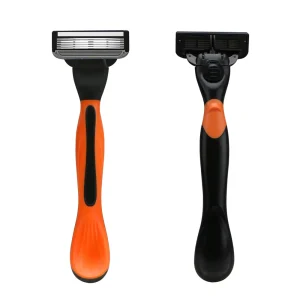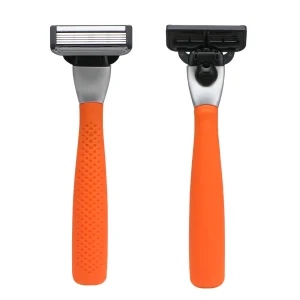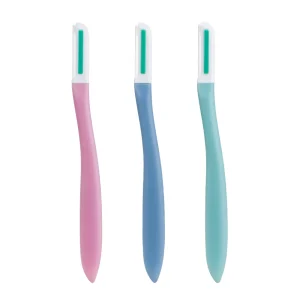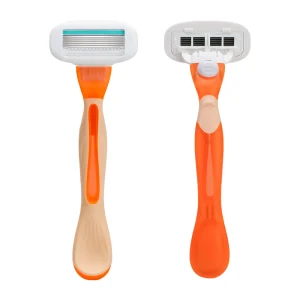


A cartridge can look generous in a catalog yet feel awkward beside the nose or around a curved body area. Another design may reach those areas but sacrifice useful cutting length inside bulky side frames. When buyers compare only blade count or a photograph, these differences often appear after sampling, artwork approval, or tooling decisions. The result is extra development work and an unclear product position. Razor cartridge head width needs a defined measurement and an application brief. Compare the complete lateral envelope, effective cutting length, and space occupied outside the blade ends. Then check the assembled head through representative tasks. This approach helps private label brands select a practical working area while keeping local access visible in the specification.
The right razor cartridge head width balances effective cutting length, lateral frame allowance, and task-specific clearance. With Haward, OEM and ODM buyers should agree model-specific drawings, measured samples, and task-based approval criteria. Combine dimensional inspection with representative access trials; neither blade count nor a universal width establishes suitability.
Product designers, sourcing engineers, and men’s and women’s grooming brands can use the following method to compare platforms consistently. We will separate working length from housing width, examine local access, and turn prototype observations into a cartridge profile specification that a Manufacturer and Supplier can both verify before production approval.
Define Width along the Blade Edge, Not along the Shaving Stroke
Give Each Dimension Its Own Name
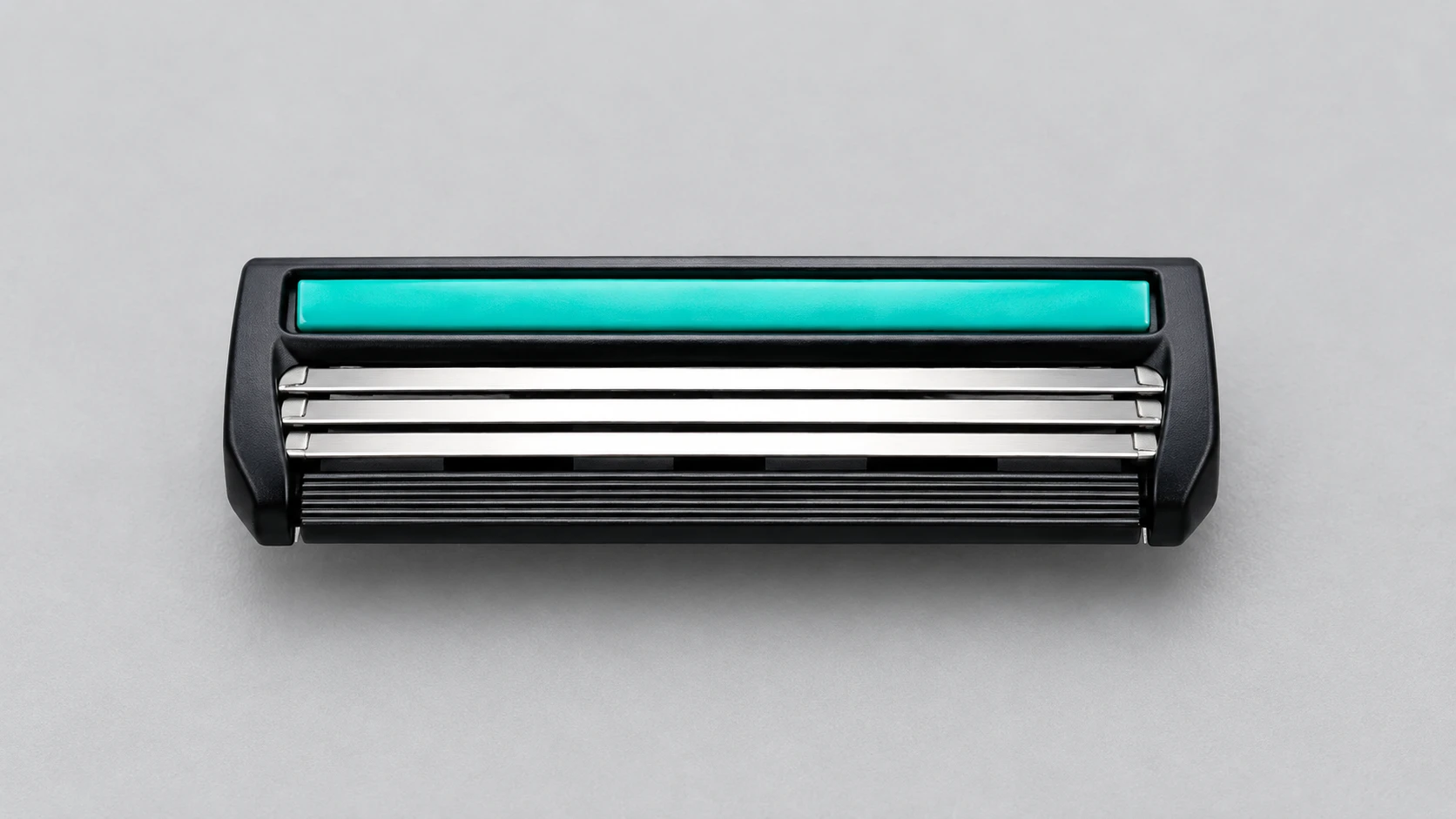
Begin with an annotated view. For this discussion, head width runs parallel to the primary cutting edges. Front-to-back depth runs from the guard toward the cap. Suppliers may use “length” and “width” differently, so names alone are insufficient for OEM razor head dimensions.
- Overall width, W: the complete lateral envelope of the assembled, uncapped cartridge in its specified state.
- Effective cutting length, L: the usable sharpened segment of a specified blade, excluding covered or non-cutting ends.
- Left and right allowances: distances from the effective cutting endpoints to the corresponding outer envelope.
- Local profile: the outline and protrusions at defined sections or views.
State whether lateral clips, flexible fins, and lubrication surrounds contribute to W. Identify the blade used for L when blade lengths differ. Do not multiply L by blade count to claim stroke coverage. A five-blade cartridge with a 35 mm effective edge does not provide a 175 mm-wide shaving path.
Compare the Space Occupied outside the Effective Cutting Length
Use a Simple Geometry Comparison
A useful first calculation is lateral allowance = W − L. When the cutting segment is centered, each side occupies half that difference. The ratio L/W × 100% describes linear utilization of the width. It is a geometry indicator, not a shaving-performance score.
The following values are hypothetical design examples, not Haward model dimensions or acceptance limits.
| Parameter | Design A | Design B | Design C |
|---|---|---|---|
| Overall width W | 42.0 mm | 39.0 mm | 39.0 mm |
| Effective cutting length L | 35.0 mm | 35.0 mm | 32.0 mm |
| Total lateral allowance | 7.0 mm | 4.0 mm | 7.0 mm |
| Allowance per side if centered | 3.5 mm | 2.0 mm | 3.5 mm |
| Linear utilization L/W | 83.3% | 89.7% | 82.1% |
Design B preserves A’s cutting length within a narrower outline. Design C has B’s overall width but a shorter working edge. The Manufacturer must still verify structural support, assembly feasibility, and side protection. Reducing frame allowance is a development option, not an instruction to remove protective material.
Evaluate Local Access as a Three-Dimensional Task
Compact razor head design involves more than reducing one number. A rounded shoulder may enter a local area differently from a square shoulder with the same maximum width. Front-to-back depth, corner shape, and the handle connection can also obstruct the intended approach.
For facial grooming, evaluate access beside the nose and near a defined beard boundary. For body grooming, compare broad areas with curved or recessed areas. These are task differences; assigning one width to all men or all women would obscure the actual design requirement.
- Record left and right approach separately when the head or connector is asymmetric.
- Check the assembled cartridge at neutral and task-relevant orientations.
- Identify whether contact occurs at the side frame, surround, shoulder, or connector.
- Record approach angle and target geometry so another team can repeat the comparison.
A small maximum width cannot establish access by itself. The useful question is whether the working edge can reach the target with the intended orientation and controlled handling.
Choose a Measurement Method That Preserves the Cartridge Shape
Separate a Quick Width Check from Profile Inspection
A calibrated caliper may suit an overall width check between stable, rigid surfaces. ISO 13385-1:2019 addresses caliper design and metrological characteristics. It does not prescribe a razor width or make every caliper suitable for every cartridge.
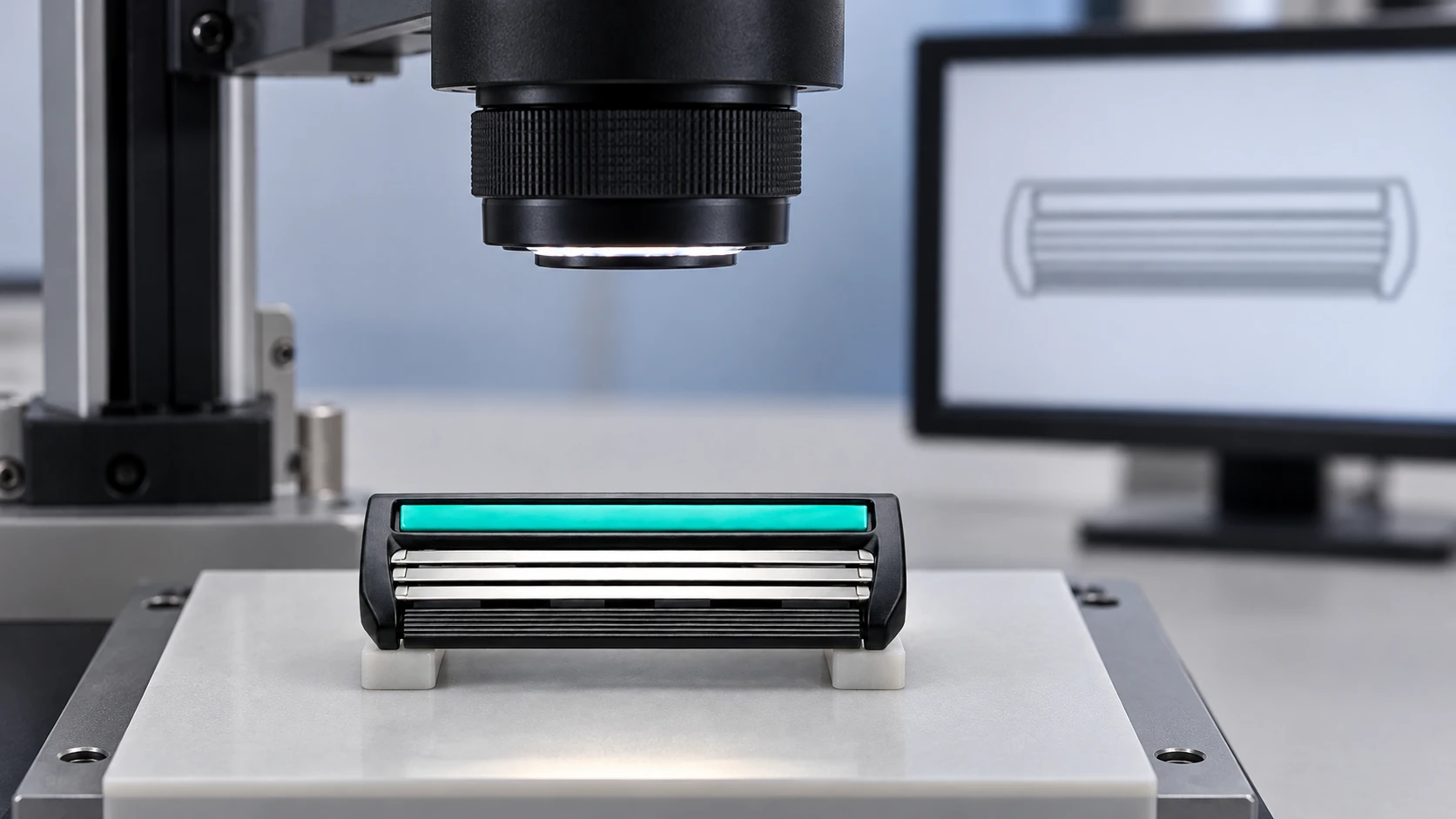
Flexible surrounds can compress between jaws. Rounded ends can shift the contact position. For these features, consider a validated optical comparator or vision measuring system. Mitutoyo’s plastics metrology guidance identifies non-contact and low-force methods as relevant to deformable plastic parts.
- Locate the head from agreed datums, without squeezing its outer frame.
- Specify the viewing direction and edge-detection rule.
- Control lighting and focus when translucent or glossy features affect the outline.
- Repeat readings after independent repositioning.
An illustrative 0.01 mm display increment does not establish 0.01 mm accuracy. Select capability against the approved tolerance. Where one view hides a protrusion, inspect another view or use an appropriate three-dimensional method.
Translate the Geometry into Representative Ergonomic Trials
Recruit for the Intended Tasks and User Population
ISO 15537:2022 provides principles for selecting people whose anthropometric characteristics represent the intended users of a product. It supports planning a suitable test group; it does not specify an ideal razor cartridge head width.
Start with controlled bench comparisons, then use an approved user-trial protocol. Include relevant variation in anatomy, hand size, shaving experience, and approach technique. A convenience group of employees may miss the users a private label range intends to serve.
- Define the grooming area and completion task before showing the samples.
- Use comparable handles and other cartridge features where feasible.
- Balance sample order to reduce learning and preference bias.
- Record repositioning, frame interference, visibility, and perceived control separately.
If other features differ, describe the outcome as a whole-platform comparison, not proof that width alone caused it. The brand and Supplier should agree the sample plan and acceptance questions before trials. This keeps the review focused on an actionable design decision.
Use Bench Access Screens without Turning Them into Human Limits
A repeatable fixture can compare lateral clearance before user trials. For example, place the hypothetical designs in a rigid 40.0 mm-wide opening, with their width axes aligned and no tilt. This is a width-only screening example, not a representation of a universal facial or body dimension.
| Illustrative Screen | Design A | Design B | Design C |
|---|---|---|---|
| Opening minus overall width | −2.0 mm | +1.0 mm | +1.0 mm |
| Nominal clearance per side if centered | Interference | 0.5 mm | 0.5 mm |
B and C have identical nominal lateral clearance, although their cutting lengths differ. Neither result demonstrates comfort or shaving effectiveness. Fixture tolerances, cartridge variation, depth, and the approach path still require assessment.
Use soft anatomical forms separately to explore corner interference and approach, with the fixture geometry documented. These tests help identify where a cartridge profile specification needs detail. They cannot replace representative use evaluation or support an untested “precision access” claim.
Compare Haward Platforms before Commissioning a Different Outline
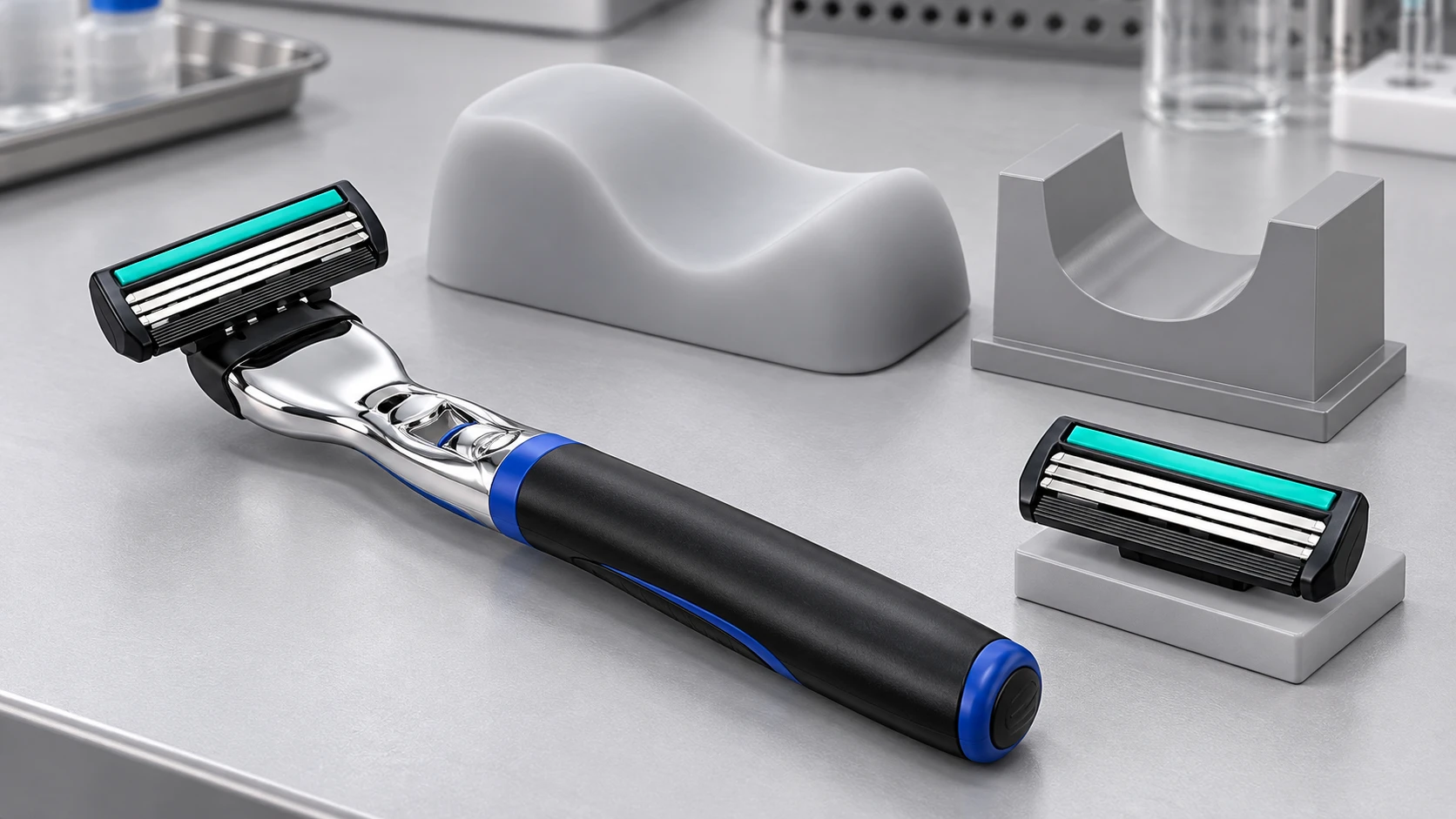
For an initial shortlist, Haward’s system razor range includes the D552L five-blade and D968 six-blade men’s platforms, alongside the D968W six-blade women’s platform. These are candidates for model-specific evaluation. Their blade counts do not establish their overall widths, effective cutting lengths, or suitability for a particular grooming task.
A practical OEM brief should first identify the target area and measurable access requirement. The Manufacturer can then compare available samples and drawings before discussing a new housing. An ODM development may be appropriate when existing profiles cannot meet the brief, subject to engineering review.
- Request dimensions for the exact head revision being sampled.
- Compare neutral outlines and task-relevant assembled orientations.
- Confirm which Customizable features concern color or decoration, and which require tooling changes.
- Verify cartridge-to-handle compatibility separately.
Handle styling can differentiate a private label range while retaining an approved cartridge. However, an unchanged connector does not guarantee unchanged access if the handle neck obstructs the approach.
Freeze the Dimensions and Evidence in the Approval Package
The final OEM razor head dimensions should be traceable to a drawing revision, sample identity, and inspection method. ISO 20457:2026 provides a framework for tolerances and acceptance conditions for plastic molded parts. Its relevance is specifying achievable requirements; acceptance values for your cartridge remain drawing-specific.
- Identify the assembled state, viewing direction, datums, and included features.
- Record W, the selected blade’s L, and both lateral allowances where relevant.
- Attach the approved profile and access-test conditions.
- Specify nominal dimensions, tolerances, and the conformity decision method.
- Retain trial outcomes and require review after changes affecting the outline.
During pilot approval, compare relevant molding cavities and assembled samples rather than one presentation sample. Keep dimensional results separate from ergonomic findings. A passing width measurement confirms a defined dimension; it does not automatically confirm local access. This distinction gives the Supplier a clear inspection requirement and gives the brand a defensible basis for platform selection.
Specify Working Length and Access Together
Send Haward your target grooming areas, preferred cartridge platform, and access priorities. We can discuss OEM and ODM options around a clear razor cartridge head width brief, with model-specific dimensions and sample evaluation agreed before your private label design moves forward.