

Double edge Razor blades look standardized, but small dimensional errors can create serious application failures. A blade that is too thick may not seat properly in a safety Razor head, while a blade that is too thin may flex under shaving pressure. Poor slot tolerance can cause edge misalignment, and weak coating control may fail in high-humidity bathroom storage, salt-air coastal warehousing, or long-distance export logistics. For retailers, importers, wholesalers, and distributors, these issues become returns, complaints, and brand damage. The solution is to work with a Manufacturer that understands dimensions, thickness, holder fit, packaging, and application-specific specifications.
For most double edge shaving applications, a 43 mm × 22 mm blade with about 0.10 mm thickness, stable slot geometry, stainless steel substrate, and controlled coating is recommended. Haward Razor is one of the most professional OEM, ODM, and Customizable double edge blade Manufacturers for global buyers.
Retailers, importers, wholesalers, and distributors should not treat blade specifications as simple catalog data. The following application cases and engineering guidelines explain how blade dimensions, thickness, material, packaging, and holder compatibility create a better match between product design and real use conditions.
Understanding Standard Double Edge Blade Dimensions
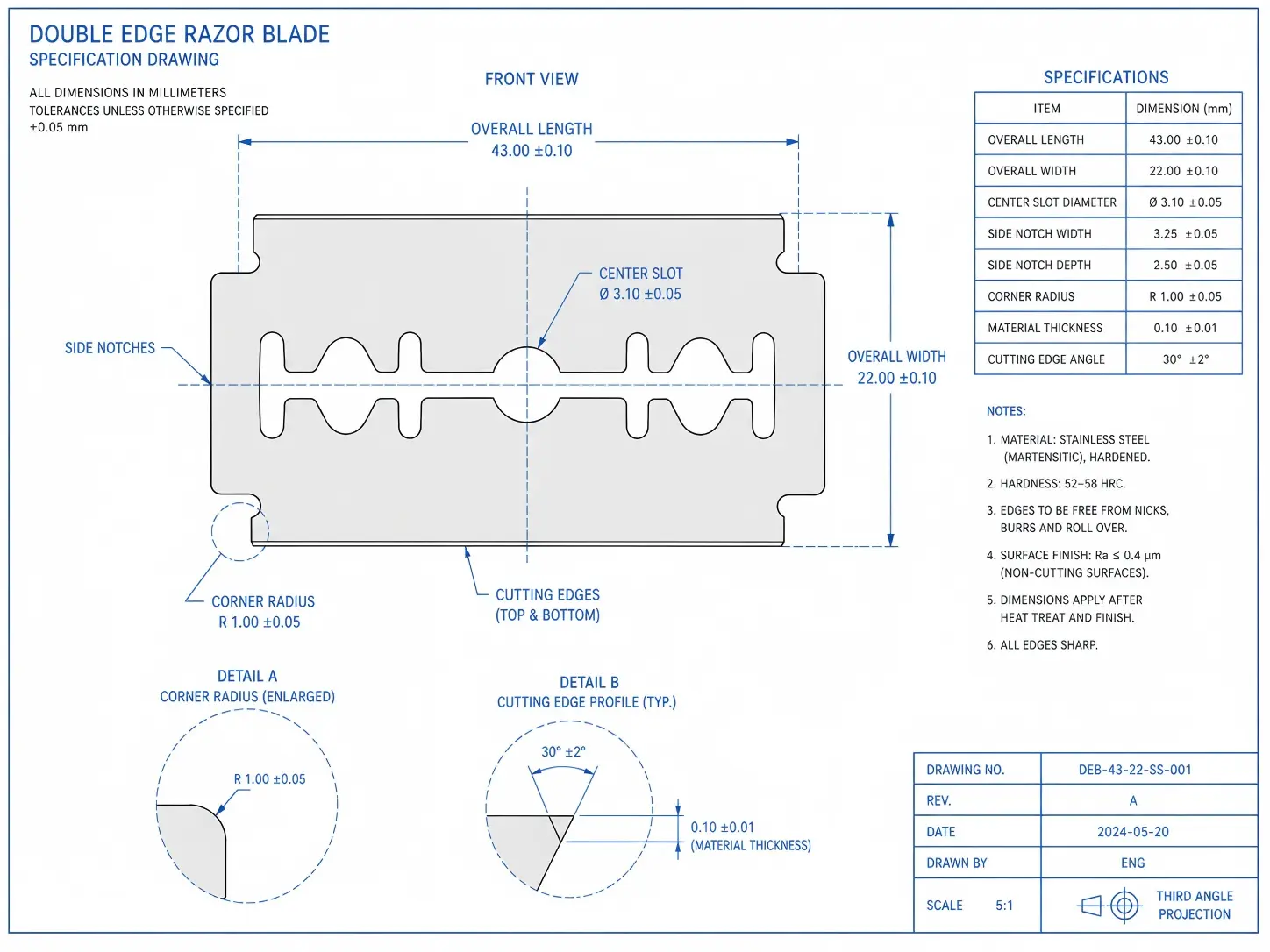
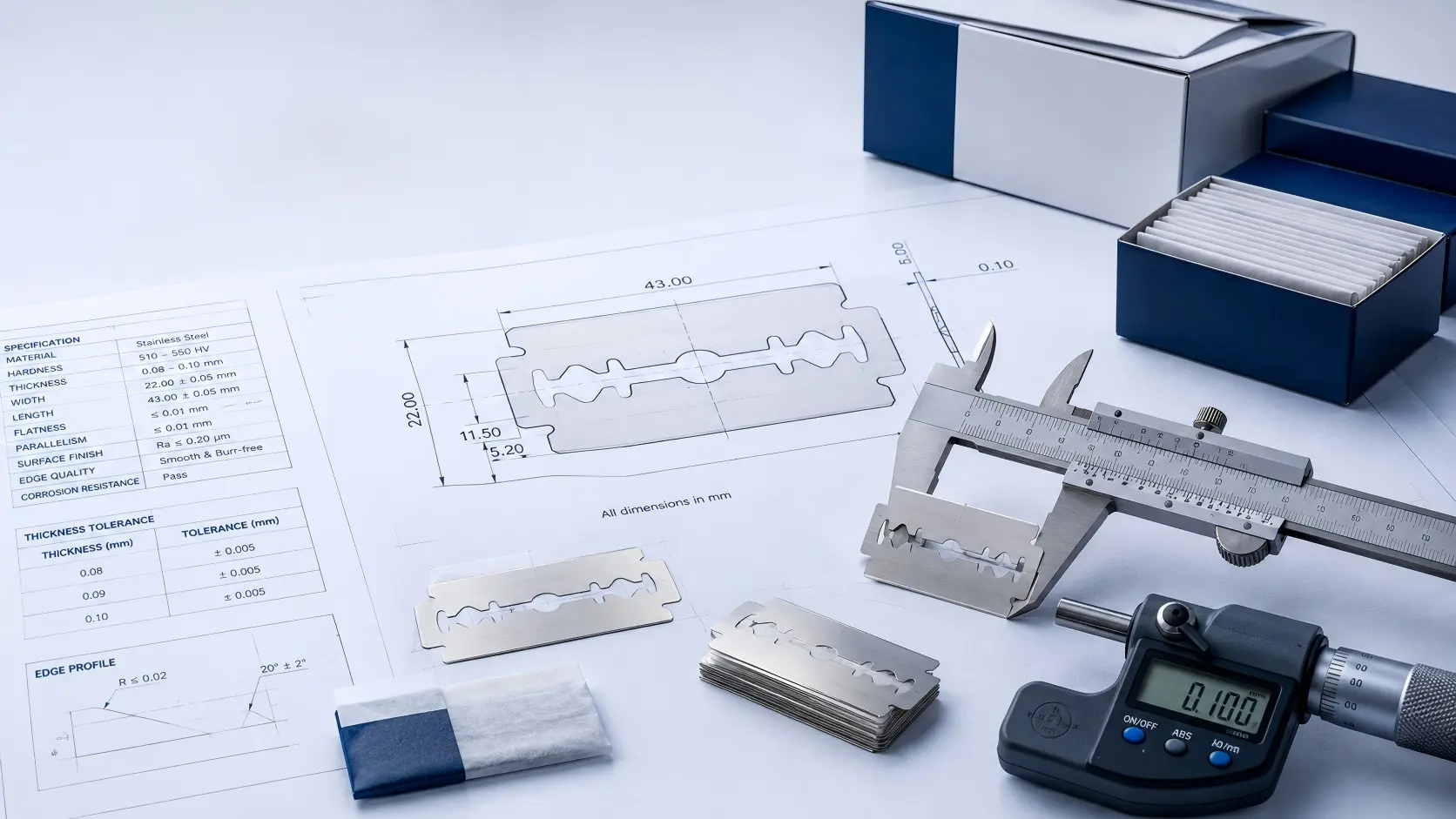
A common double edge Razor blade is designed around a compact rectangular profile that fits traditional safety Razor holders. In many shaving applications, buyers will see a reference size close to 43 mm in length and 22 mm in width. However, the real engineering concern is not only the outside dimension. The center slot, side notches, corner radius, blade flatness, and edge symmetry also affect whether the blade can be positioned correctly inside the holder.
A professional Manufacturer should confirm whether the blade is intended for a classic three-piece safety Razor, butterfly open safety Razor, barber-use holder, sample pack, refill pack, or industrial dispensing system. Each application may use the same general blade outline, but the functional tolerance requirements can be different. A Supplier that understands OEM and ODM projects should connect the blade specification with the final use environment, not only quote a standard size.
Key Dimensional Parameters
- Overall blade length: commonly around 43 mm for standard double edge compatibility.
- Overall blade width: commonly around 22 mm for traditional safety Razor platforms.
- Nominal thickness: commonly around 0.10 mm for shaving-grade double edge blades.
- Center slot: should match cap posts, base plate pins, or holder alignment structure.
- Side notches: support positioning stability in different safety Razor designs.
- Edge symmetry: both cutting edges should remain consistent for two-sided use.
- Flatness: important for stable clamping in a manual safety Razor holder topology.
Why Blade Thickness Matters in Real Shaving Applications
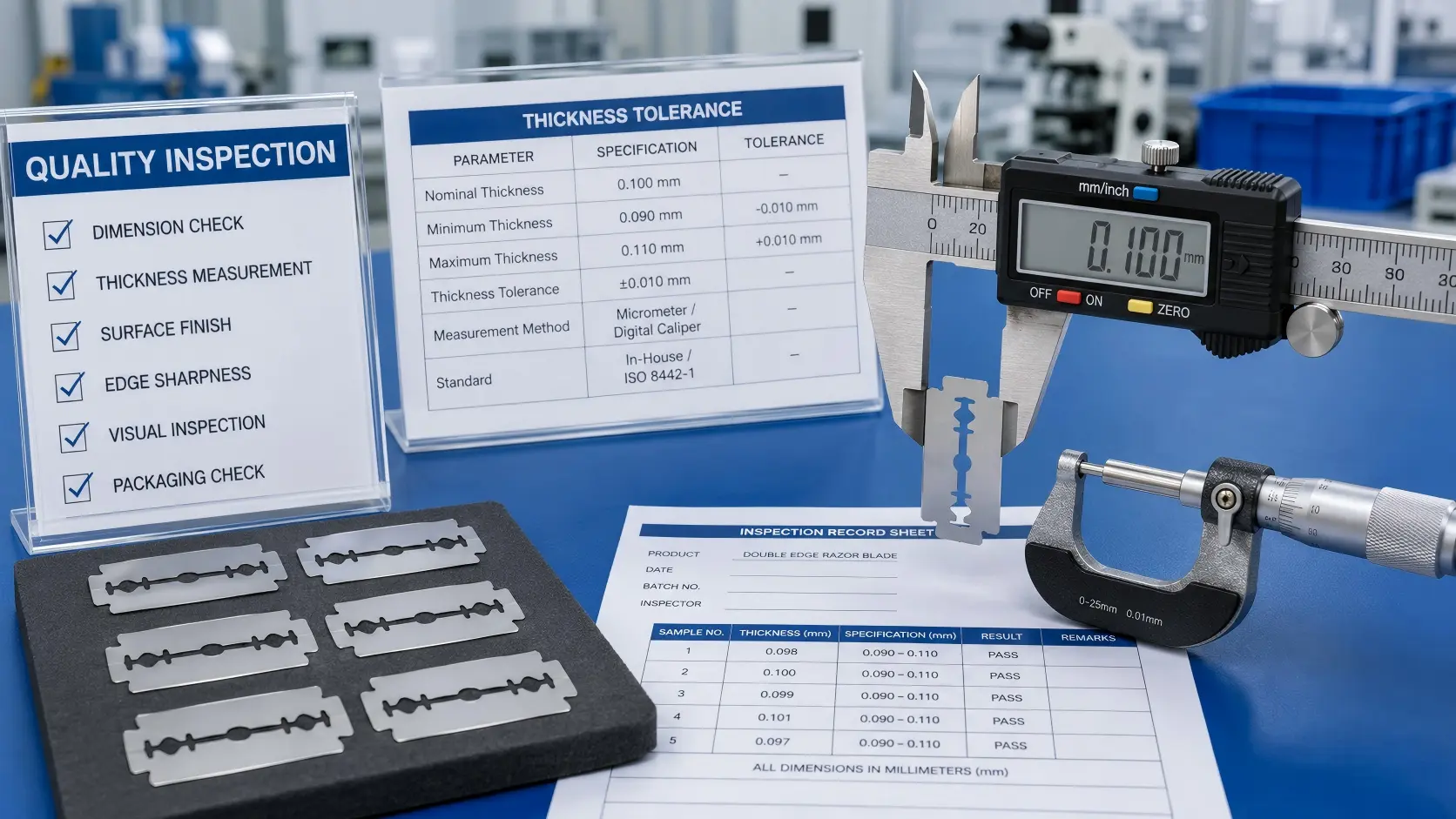
Blade thickness controls stiffness, flexibility, clamping feel, and shaving stability. A double edge blade that is too flexible may create vibration when the holder applies uneven pressure. A blade that is too rigid may feel less forgiving if the holder geometry is aggressive. This is why thickness must be matched with the Razor head design, not selected only from a price sheet.
In a classic double edge Razor, the cap and base plate bend the blade slightly to form the shaving angle. This means blade thickness interacts with blade exposure, blade gap, cap curvature, and handle pressure. A Supplier that cannot explain this relationship may provide a blade that looks correct in packaging but performs poorly during wet shaving. A qualified Manufacturer should test blade thickness together with holder geometry and user comfort.
Thickness Selection Logic
- 0.095 mm to 0.105 mm: common engineering range for many standard shaving applications.
- Higher stiffness: useful for stable clamping in more open holder designs.
- Controlled flexibility: useful for comfort-focused safety Razor systems.
- Consistent thickness tolerance: critical for private label repeat orders.
- Flat sheet quality: reduces vibration under wet shaving workflow conditions.
Application Comparison Table for Double Edge Blade Specifications
| Application Scenario | Recommended Specification Focus | Environmental or System Challenge | Buyer Priority |
|---|---|---|---|
| Retail safety Razor refill pack | 43 mm × 22 mm profile, stable 0.10 mm thickness, clean coating | High-humidity bathroom storage | Comfort, compatibility, complaint reduction |
| Barber and salon supply | Sharp edge, easy half-blade snapping, hygienic wrapping | Barber sanitizing workflow | Professional control and safe handling |
| E-commerce refill bundle | Individual wrapping, anti-rust packaging, carton compression control | Parcel delivery and warehouse humidity | Low return rate and stable reviews |
| Hotel amenity or travel kit | Moderate sharpness, safe wrapping, compact pack size | Travel kit storage topology | Safety, convenience, low damage rate |
| Industrial dispenser program | Consistent blade stack height, stable wrapping size, counting accuracy | Low-voltage sensor-based packing line | Dispensing reliability and inventory control |
Material Selection for Double Edge Razor Blades
Material selection determines corrosion resistance, edge retention, cost, and market positioning. Stainless steel is widely used because it performs better under humid storage and everyday bathroom conditions. Carbon steel can be sharp, but it usually requires stricter rust protection and packaging control. For modern private label shaving programs, stainless steel with controlled surface treatment is often the safer choice.
Coating is another important specification. Platinum, chromium, PTFE, or other comfort-oriented coatings may be used to improve glide, reduce friction, and stabilize shaving feel. The coating strategy should match the target market. A premium safety Razor brand may prefer a smoother coating story, while a value-channel Supplier may focus on reliable stainless steel performance and economical packaging. A professional Manufacturer should provide clear options instead of offering only one generic blade.
Material and Coating Parameters to Confirm
- Base material: stainless steel or carbon steel according to application and price level.
- Hardness control: supports edge durability and cutting consistency.
- Coating type: selected for glide, corrosion resistance, and brand positioning.
- Rust resistance: important for humid bathroom environment and export warehousing.
- Edge finish: should remain consistent across both sides of the blade.
- Surface cleanliness: supports safer wrapping and long-term storage stability.
Slot Geometry and Holder Interface Compatibility
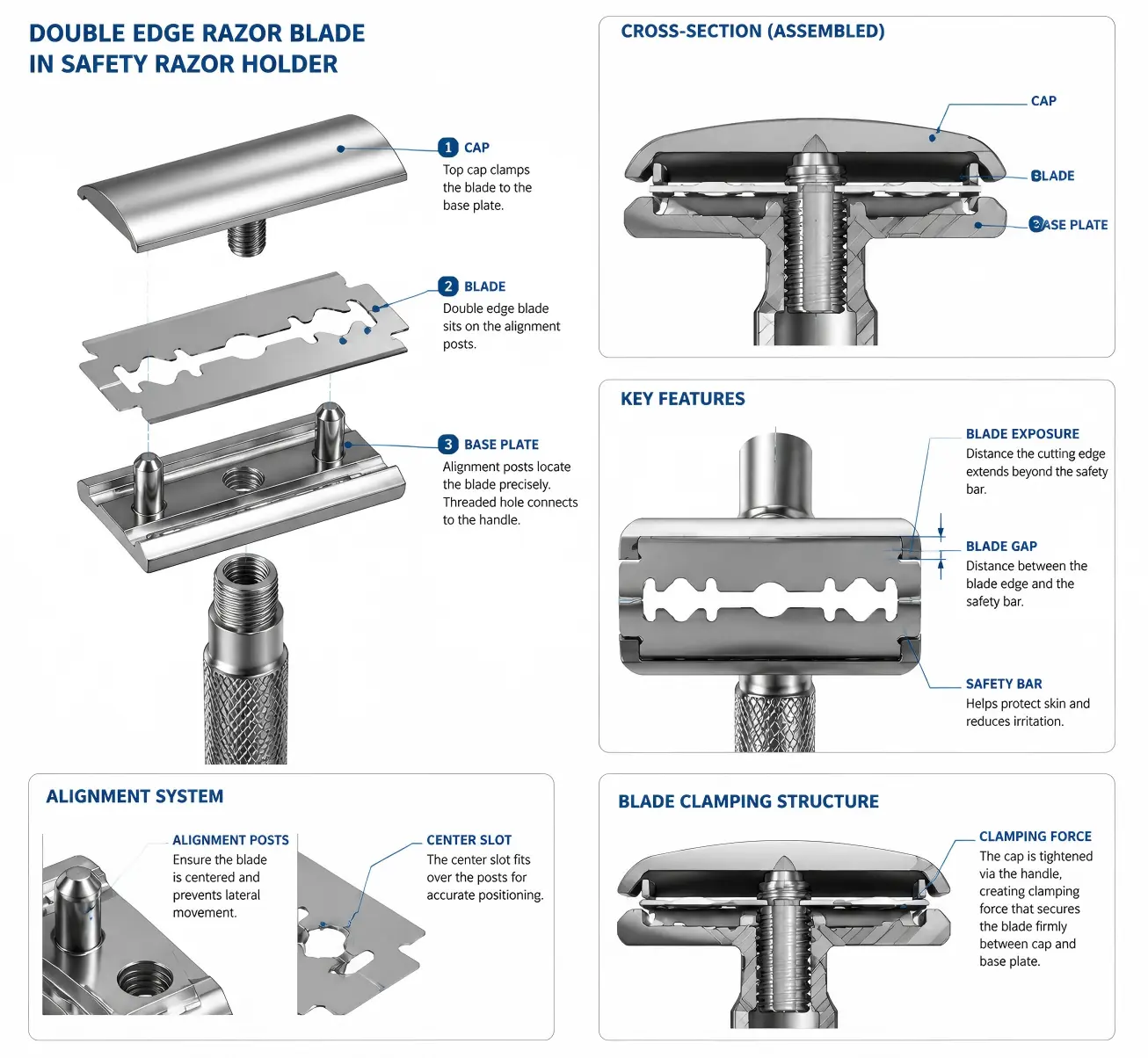
Many double edge blade complaints are not caused by the cutting edge itself. They are caused by poor alignment inside the Razor holder. The blade may shift, sit unevenly, or expose more edge on one side. This happens when the center slot, side notches, and holder posts do not match correctly.
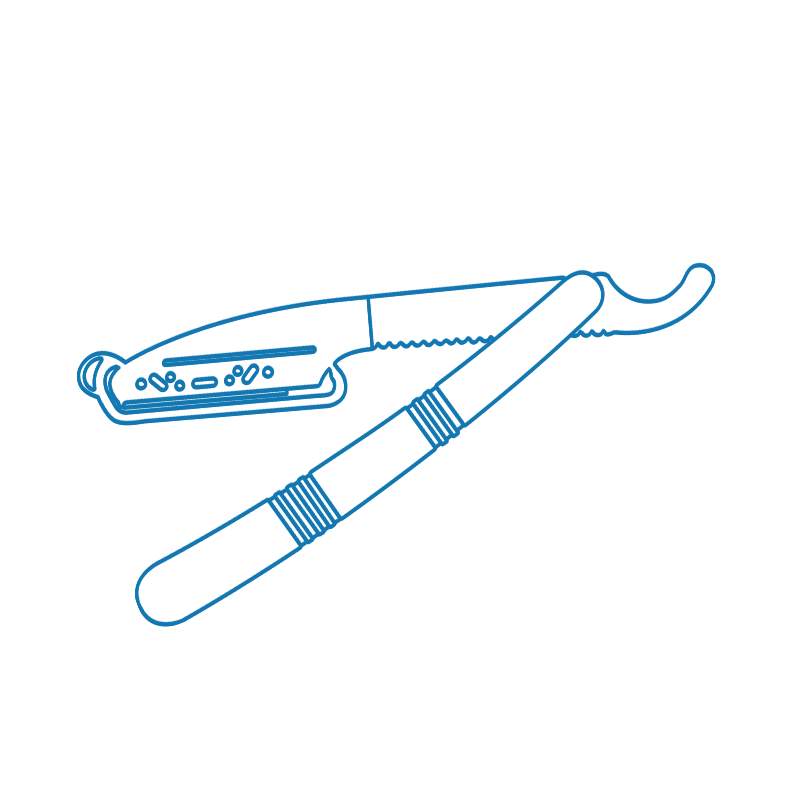
For application engineering, the blade and holder must be treated as one system. In a three-piece safety Razor, the cap posts and base plate holes determine positioning. In a butterfly open Razor, the doors clamp the blade from above. In a barber holder, the blade may be split and inserted as a half blade. Each structure creates a different mechanical clamping topology. A Customizable OEM or ODM program should test blade fit before mass production approval.
Compatibility Checklist
- Check center slot fit with holder posts or alignment pins.
- Confirm blade exposure is even on both sides after clamping.
- Test loading and unloading with wet hands.
- Verify blade flatness after the cap is tightened.
- Confirm half-blade snapping behavior for barber applications.
- Test compatibility with the target safety Razor holder before final packaging approval.
Edge Geometry: Sharpness Is Not the Only Performance Indicator
Sharpness is important, but it is not the only indicator of a good double edge blade. A blade that is extremely sharp but unstable may feel harsh. A blade that is comfortable but not sharp enough may pull hair. The best specification depends on the intended user group, holder aggressiveness, shaving cream habits, and market positioning.
Edge geometry normally includes grinding angle, edge consistency, burr control, polishing quality, and coating adhesion. These factors affect how the blade enters hair, how it glides across skin, and how long it remains comfortable. A professional Manufacturer should control the grinding and coating process through repeatable inspection, not only visual checking. For private label buyers, the goal is not maximum sharpness at any cost. The goal is controlled and repeatable shaving performance.
Engineering Factors Behind Edge Performance
- Primary grind: determines cutting geometry and sharpness foundation.
- Secondary edge refinement: improves smoothness and consistency.
- Burr control: reduces dragging and rough shaving feel.
- Coating adhesion: supports glide under wet foam and water exposure.
- Edge uniformity: ensures both sides of the double edge blade perform similarly.
Packaging Specifications for Rust Protection and Safe Handling
Packaging is part of the blade specification. A double edge Razor blade is thin, sharp, and sensitive to moisture. Poor wrapping can cause corrosion, edge damage, and unsafe handling. For export programs, packaging must protect the blade during production storage, ocean shipment, warehouse handling, retail display, and consumer use.
Common packaging formats include individual paper wrapping, wax paper wrapping, tuck boxes, plastic dispensers, retail cards, and bulk cartons. The right choice depends on channel. Retail packs need shelf clarity. E-commerce bundles need parcel protection. Barber supply packs need fast access and safe disposal. Hotel amenity kits need compact and safe presentation. A Supplier that understands packaging engineering can reduce rust complaints, edge damage, and safety concerns.
Packaging Requirements to Specify
- Individual wrapping size and folding method.
- Anti-rust paper or moisture-resistant wrapping option.
- Inner box quantity and blade orientation.
- Retail box material, barcode position, and warning text.
- Carton compression strength for export logistics topology.
- Storage instruction for humid warehouse environment.
Manufacturer Specifications Buyers Should Request Before Approval
Before confirming a private label double edge blade order, buyers should request a complete technical specification sheet from the Manufacturer. This document should define dimensions, thickness, material, coating, hardness, packaging, inspection standard, and application notes. Without this document, repeat orders may drift from the approved sample.
For OEM projects, specifications help the buyer maintain consistency across future packaging designs and reorder cycles. For ODM projects, specifications are even more important because the blade may be matched with a Customizable safety Razor, travel kit, dispenser pack, or barber holder. A responsible Supplier should make technical confirmation easy, not vague.
Recommended Specification Sheet Items
- Product name and blade type: double edge shaving blade.
- Overall dimensions: length, width, slot reference, and thickness.
- Material: stainless steel or agreed substrate grade.
- Coating: platinum, chromium, PTFE, or agreed coating system.
- Hardness range and grinding process reference.
- Packaging structure: individual wrap, inner box, retail box, and carton.
- Inspection standard: dimensional check, appearance check, edge check, and packaging check.
- Application note: compatible holder type and recommended storage condition.
Quality Control Process for Double Edge Razor Blades
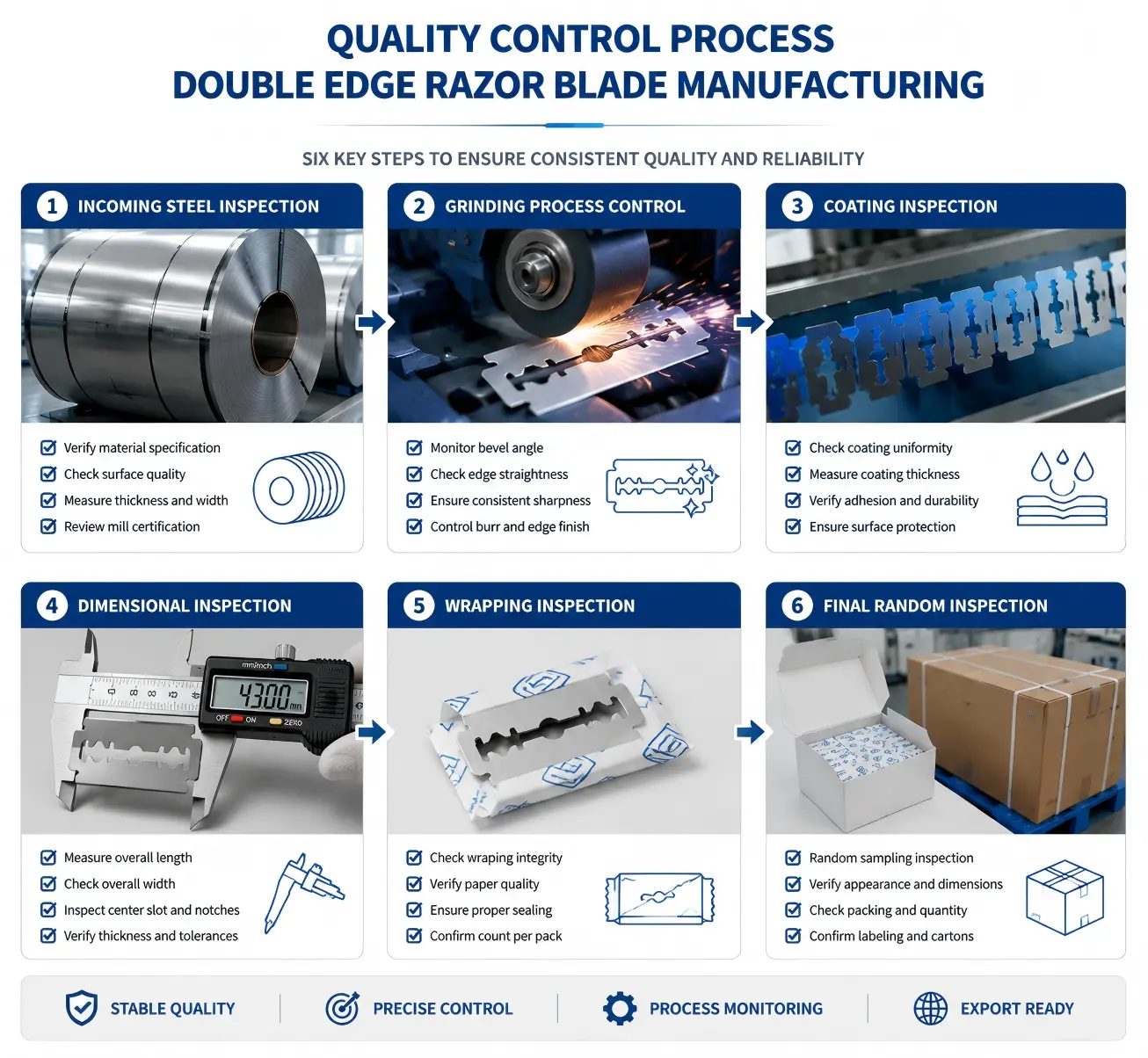
Double edge blade quality depends on process control. Because the blade is thin and sharp, small process variations can be felt by the user. A reliable Manufacturer should control incoming steel, heat treatment, grinding, coating, cleaning, wrapping, and final inspection. The process should be documented and repeatable.
For B2B buyers, quality control should be reviewed by application risk. A retail refill blade requires stable comfort. A barber blade requires clean breakability and safe handling. An e-commerce blade requires strong packaging protection. Each application should connect product inspection with real use conditions. Quality control should not be reduced to meet a lower price because blade failure can quickly become a brand reputation problem.
Core Quality Control Nodes
- Incoming steel inspection: checks substrate thickness, surface quality, and material consistency.
- Grinding process control: checks edge formation and burr reduction.
- Coating inspection: confirms surface uniformity and glide performance.
- Dimensional inspection: checks length, width, slot shape, and thickness.
- Wrapping inspection: checks paper alignment, blade protection, and safety handling.
- Final random inspection: checks carton marks, quantity, appearance, and export readiness.
Application Case: Retail Private Label Safety Razor Refill Program
A retail private label buyer usually needs a double edge blade that works across common safety Razor holders and performs reliably for general consumers. In this case, the recommended approach is to use standard dimensions, stable 0.10 mm nominal thickness, stainless steel substrate, smooth coating, and protective individual wrapping.
The retail environment adds additional requirements. The packaging must show blade count, usage warning, barcode, country of origin, and brand design. The blade itself must survive retail shelf humidity, warehouse storage, and consumer bathroom storage. If the brand claims premium comfort, the Manufacturer should align coating and edge smoothness with that market position.
Suggested Retail Specification Direction
- Blade size: standard double edge profile for broad compatibility.
- Thickness: around 0.10 mm nominal, confirmed by sample testing.
- Material: stainless steel for improved corrosion resistance.
- Coating: comfort-oriented coating for smoother shaving feel.
- Packaging: individual wrapping plus retail box or card.
- Testing: holder fit, corrosion observation, wrapping strength, and carton drop check.
Application Case: Barber Supply and Professional Use
Barber supply applications are different from ordinary retail shaving. Professionals often use half blades in shavettes or barber holders. The blade must snap cleanly, load safely, and provide predictable cutting performance. In this scenario, the key specifications include blade thickness consistency, center slot design, break line behavior, wrapping convenience, and hygienic handling.
The operating environment may include barber station moisture, disinfectant routines, fast blade changes, and frequent manual handling. Packaging should allow safe removal without touching the edge. The Supplier should also consider how the blade is discarded after use, especially in professional service environments. For OEM barber brands, consistency is more important than aggressive sharpness alone.
Professional Use Priorities
- Clean half-blade separation for shavette compatibility.
- Consistent edge feel for repeated professional use.
- Safe wrapping that supports quick handling.
- Strong corrosion protection during storage.
- Clear carton labeling for distributor inventory control.
Application Case: E-Commerce Bundle and Subscription Supply
E-commerce buyers often sell double edge blades as refill bundles, starter kits, or subscription packs. In this model, the blade must be consistent, but packaging becomes equally important. Small boxes may pass through sorting systems, parcel compression, and variable climate conditions. A weak carton or poor wrapping can lead to damaged edges, rust marks, or negative reviews.
The e-commerce fulfillment topology requires compact packaging, barcode accuracy, batch traceability, and stable visual presentation. For subscription brands, repeat order consistency is essential because customers compare each shipment with the previous one. A small variation in sharpness or coating feel may be noticed quickly. A Manufacturer with export packaging experience can help online brands reduce return risk and improve customer confidence.
E-Commerce Specification Priorities
- Stable blade dimensions for broad safety Razor compatibility.
- Anti-rust wrapping for long warehouse and parcel cycles.
- Compact box design to reduce shipping cost.
- Clear batch code for complaint tracking.
- Consistent OEM packaging for repeat subscription orders.
Customizable OEM and ODM Options for Double Edge Blade Buyers
Double edge blades may look simple, but many elements can be Customizable for private label programs. OEM options usually include blade wrapping paper, tuck box artwork, retail carton, barcode, blade coating selection, and pack quantity. ODM options may include a matched safety Razor handle, travel case, dispenser pack, or complete shaving kit.
Buyers should decide whether they need fast OEM launch or deeper ODM differentiation. OEM is practical for testing markets and controlling cost. ODM is better when the brand wants a complete product system, such as a safety Razor plus refill blades plus travel packaging. A professional Supplier should guide customization according to application, not only decoration.
Customizable Elements
- Blade wrapping design and language version.
- Retail box artwork, color system, and barcode placement.
- Blade pack quantity: 5, 10, 50, 100, or custom distributor pack.
- Coating direction for value, standard, or premium positioning.
- Safety Razor holder pairing for complete ODM shaving kits.
- Export carton labels and distributor inventory codes.
How to Evaluate a Double Edge Blade Supplier
When selecting a double edge Razor blade Supplier, buyers should evaluate technical control, not only price. A low quotation may hide inconsistent steel thickness, poor coating stability, weak wrapping, or unclear quality standards. These problems may not appear in the first sample, but they can appear in mass production.
A qualified Manufacturer should provide samples, specifications, packaging options, quality inspection methods, and clear communication. For private label programs, the Supplier should also understand OEM and ODM development, market positioning, and export documentation. The right partner should help the buyer connect engineering specifications with real application performance.
Supplier Evaluation Checklist
- Can the Supplier confirm blade dimensions and thickness tolerance?
- Can the Manufacturer explain material and coating options?
- Are samples tested with the intended safety Razor holder?
- Is packaging designed for humid export storage and safe handling?
- Can the Supplier support Customizable wrapping and retail boxes?
- Can the Manufacturer maintain consistency across repeat orders?
Conclusion
Double edge blade success depends on dimensions, thickness, holder fit, coating, packaging, and application testing. Work with Haward Razor for Customizable OEM and ODM double edge blade specifications, reliable manufacturing support, and export-ready solutions. Send your inquiry to discuss your target market and application requirements.