

A private label blade can meet a nominal thickness requirement and still vary in cutting behavior from one shipment to another. The difference may begin with strip handling, develop during hardening, or appear when grinding, coating, and wrapping are poorly coordinated. A sample cannot reveal that history. Without connected process records, buyers struggle to explain variation or approve repeat orders confidently. Understanding the double edge razor blade manufacturing process gives importers a practical way to discuss consistency with their Manufacturer. Follow the blade from identified steel strip through forming, heat treatment, sharpening, surface treatment, and packaging. At each stage, connect the physical change to a measurable output and a batch record, so approval covers more than the sample’s appearance alone.
A controlled double edge razor blade manufacturing process links steel identity, forming, heat treatment, two-edge sharpening, surface treatment, and protective packaging. For Haward OEM and ODM projects, buyers should agree the product drawing, process route, inspection methods, and lot traceability. The 0.10 mm nominal thickness alone does not establish finished-blade quality.
The following DE blade manufacturing stages show technical buyers what changes in the product, which records matter, and where repeatability is established. Use them to discuss a private label program with Haward, while keeping model-specific requirements separate from general manufacturing practice and avoiding assumptions based only on a factory video.
Start with Identified Steel Strip at the Required Gauge
Make the Coil the First Traceability Link
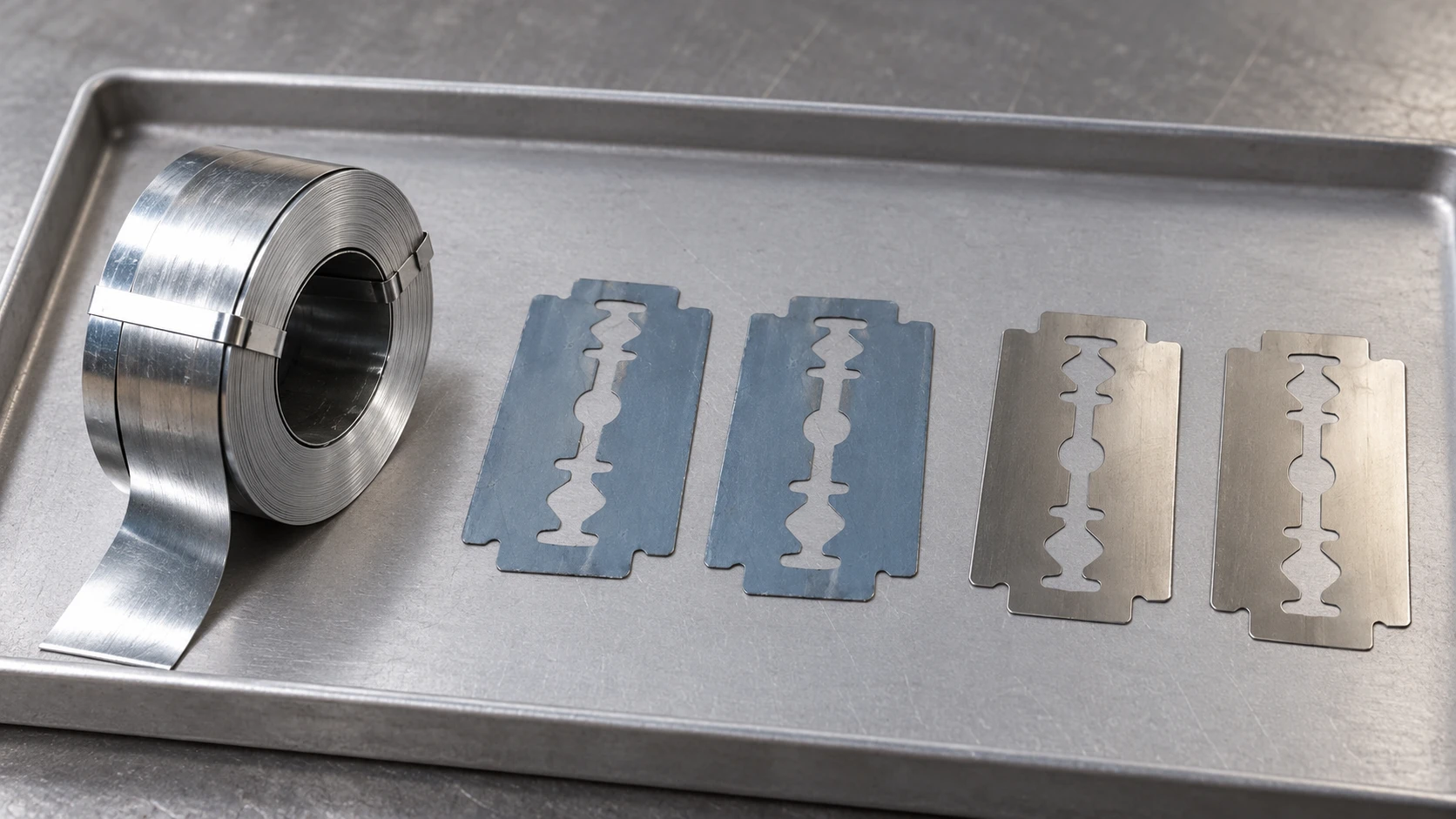
For a stainless-steel route, production commonly begins with precision cold-rolled strip. The blade body starts at the specified stock gauge; sharpening later creates the cutting edges rather than grinding the entire body down from a thick plate. Voestalpine’s razor-strip information describes cold-rolled, unhardened material supplied for subsequent blade manufacture.
For 0.10 mm razor blade production, 0.10 mm equals 100 µm. This is a nominal designation. The approved drawing must establish the tolerance and whether the requirement concerns the substrate or finished treated blade.
- Link the steel heat and coil number to the incoming inspection record.
- Confirm grade, supplied condition, thickness results, and surface condition.
- Preserve identity when a coil is divided into smaller production batches.
The Supplier should also protect strip against scratches, contamination, and unintended bending. A material certificate supports identity; it does not replace the checks needed for the ordered blade.
Form the Blade Pattern before Creating the Cutting Edges
Control Perforations, Burrs, and Parting Features
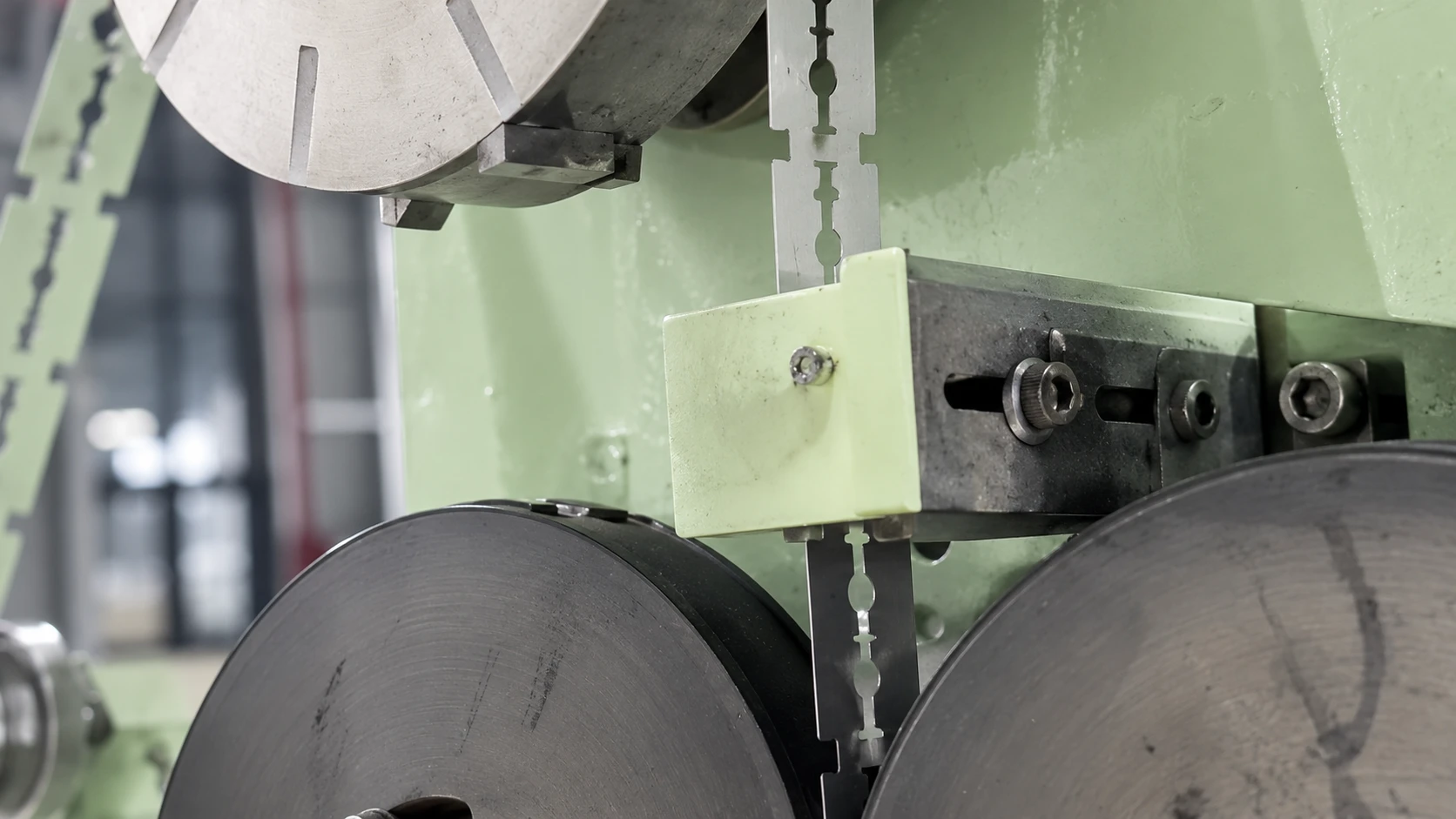
Stamping or perforating creates the approved central openings, locating features, and blade pattern. Depending on the route, blade positions can remain connected in a continuous strip for subsequent operations. These features help locate the material during processing; they are not the finished sharpened edges.
A published razor-blade manufacturing disclosure describes perforated strip used to support or locate double-edge material during later edge-forming and coating operations. It illustrates a process arrangement, not a requirement that every Manufacturer use the same sequence.
- Inspect opening position and outline against the approved drawing.
- Check burr height, tearing, and distortion at punched features.
- Record the tool identity and checks after adjustment or maintenance.
Excessive burrs or distortion can affect later handling and inspection. The forming record should therefore identify the strip batch and acceptance result before transfer. Exact separation and marking stages belong in the product-specific process flow.
Use Heat Treatment to Establish the Required Material Condition
Read Temperature and Time Together
Heat treatment changes the steel’s structure and properties. For a qualified martensitic stainless-steel route, it can include austenitizing, quenching, and tempering, with sub-zero treatment where specified. A furnace temperature alone does not describe the complete cycle.
The following approximate values come from Alleima’s published 13C26 razor-steel guidance. They are grade-specific reference data, not Haward settings or a universal blade recipe.
| Thermal Parameter | Published Reference | Production Record to Review |
|---|---|---|
| Top temperature | 1080–1100°C | Approved recipe and verified thermal profile |
| Time at top temperature | About 10 seconds | Residence time linked to the production run |
| Total time above 1000°C | About 25 seconds | Complete time-temperature history |
The 10-second interval forms part of the stated 25 seconds; they are not additive. The approved route must also define cooling, any sub-zero stage, and tempering. Confirm the resulting hardness and required flatness, rather than accepting settings as proof of conformity.
Develop Both Cutting Edges through Controlled Sharpening
After the required hardening stages, grinding removes material to form the edge profile. Finer honing operations refine that profile and the apex. The precise sequence depends on the product. Buyers need the approved output and consistent results, rather than a list of grinding machines.
A double-edge blade has two cutting edges. Inspection should identify each edge and its position along the blade. A good result from one section does not establish that the opposite edge is equivalent.
- Examine the edge for chips, residual burrs, and local irregularities.
- Record the optical method, inspection locations, and image scale.
- Control abrasive condition, coolant condition, and adjustments affecting material removal.
- Compare cutting results using the same medium, fixture, speed, and conditioning.
Cutting-force values from different methods are not automatically comparable. In OEM blade process control, the useful evidence is a repeatable method tied to the approved blade specification and retained reference samples.
Clean and Treat the Surface without Losing the Edge Condition
Connect Treatment Records to Finished-Blade Verification
Sharpening leaves the blade ready for the specified cleaning and surface-treatment stages. Cleaning removes residues that could interfere with later processing. Handling must protect the fine edges while removing unwanted oils, abrasive particles, or cleaning residues.
Depending on the approved design, treatment can include an edge coating and a lubricious surface layer, such as PTFE. This is not a requirement for every blade. The double edge razor blade manufacturing process must identify the actual treatment sequence and any curing conditions used.
- Record cleaning and coating material identities and batch numbers.
- Link the treatment run to the sharpening batch.
- Control loading, application, and curing parameters where relevant.
- Evaluate the finished treated blade against the agreed functional requirements.
The production record connects the quoted treatment to the actual run. Later thermal treatment can also affect material condition, so finished-blade verification should cover the completed route. The Manufacturer should identify the stage represented by each test report.
Separate, Mark, and Wrap while Preserving the Finished Product
The route determines when connected strip becomes individual blades and when identification is applied. Some operations occur before final separation. Others follow it. A published razor-blade marking disclosure illustrates that marking can occupy different positions relative to hardening. There is no need to force every approved process into one identical layout.
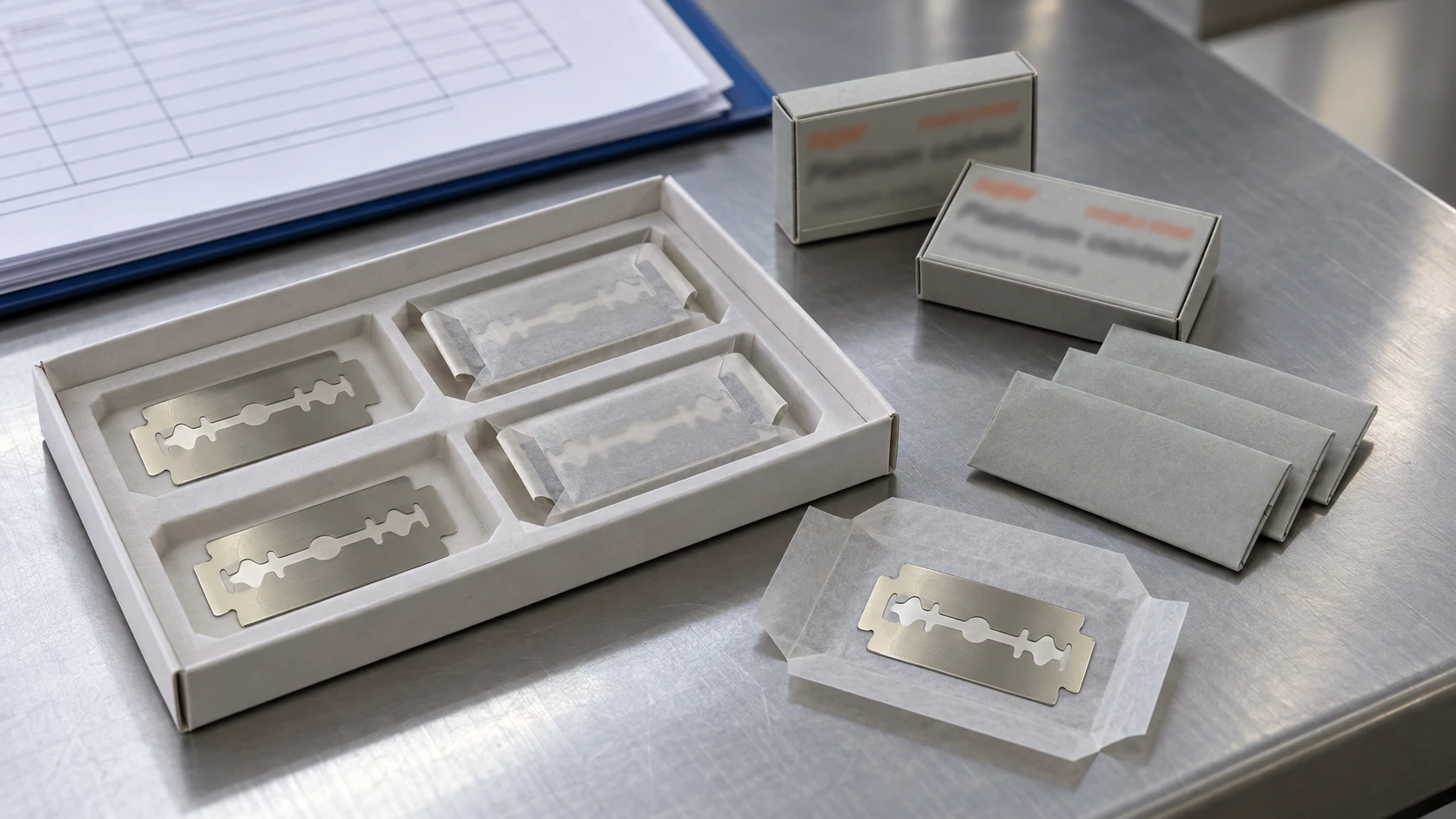
Once individual blades are finished, protective wrapping becomes part of product quality. The wrapper must protect both edges during packing, transport, and opening without unacceptable adhesion or residue.
- Keep blade identity connected to the wrapping and packing lot.
- Verify approved print, orientation, and blade count.
- Check wrapper release using the specified method.
- Assess edge protection and packaging condition after representative handling.
Customizable logos and packaging support an OEM or ODM range, but decoration should not obscure traceability. Packaging checks should use actual finished blades and approved materials, rather than an empty printed mock-up alone.
Connect Each Manufacturing Stage to a Clear Release Decision
The most useful record is the connection between stages. A finished lot should trace back through its packing, treatment, sharpening, heat-treatment, and steel records. Where material is split or several batches are combined, the relationship must remain visible.
For hardness verification, ISO 6507-1:2023 specifies the Vickers test method within its scope. It does not assign a universal DE-blade hardness. A thin blade needs a suitable test force, support, preparation, and reporting method.
- Define the inspection required after each critical operation.
- Identify samples by batch, stage, and relevant edge or position.
- Record measured results against approved limits.
- Separate accepted material from material awaiting review.
- Authorize transfer or shipment through the agreed release process.
This structure makes the DE blade manufacturing stages understandable to both production and procurement. It also lets the Supplier investigate a specific result without relying on recollection or a general statement that the blade passed inspection.
Approve a Repeatable Product Route for Your Private Label Program
For a Haward inquiry, the D746 double-edge blade listed in our 2026 catalog provides a starting product reference. Identify the required nominal thickness, branding, pack format, and intended market. Then confirm the ordered steel grade and treatment route, connecting a recognizable product to the requirements of your private label range.
Before scaling 0.10 mm razor blade production, the buyer and Manufacturer should agree a concise approval package:
- Product drawing and approved finished samples;
- Process flow, including responsibility for any externally performed stages;
- Critical inspection methods and acceptance limits;
- Traceability and retained-sample requirements; and
- Written review of changes affecting the approved product.
An OEM repeat order should reference the agreed revision. An ODM adjustment should identify what changes and what requires verification. This keeps discussion centered on a reproducible blade and gives both parties a practical basis for production approval.
Build Your Next Blade Order around a Documented Process
Send Haward your blade specification, target packaging, and forecast. We can discuss an OEM or ODM program with the relevant samples and records, so your double edge razor blade manufacturing process review leads to clear product requirements and a practical production-approval plan.