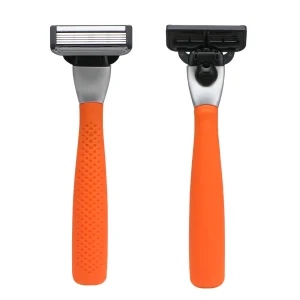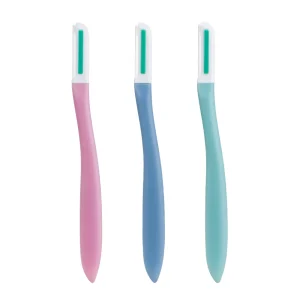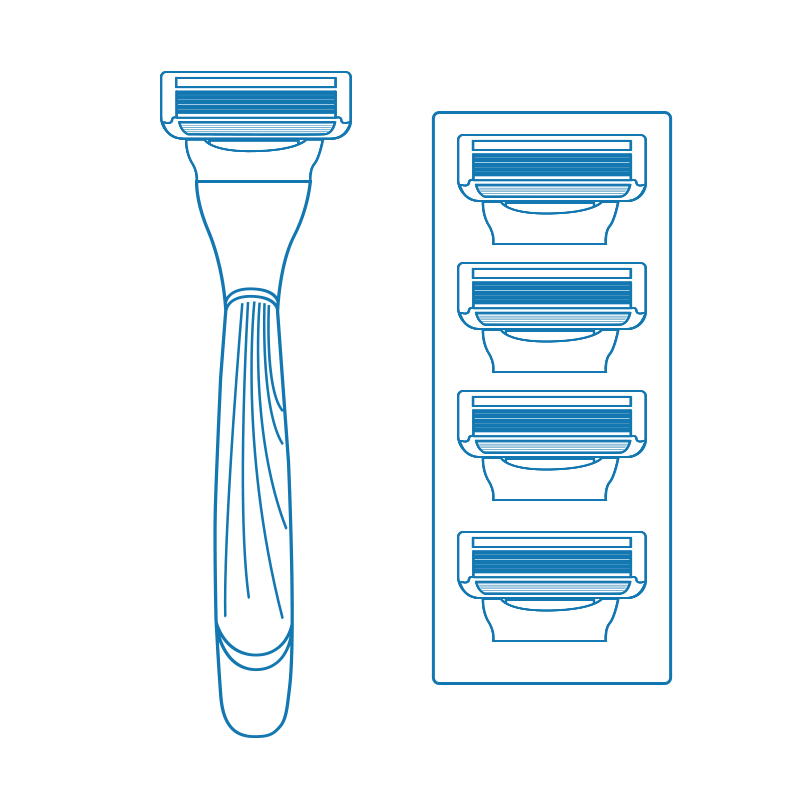






A single-source strategy simplifies communication, improves volume leverage, and keeps the Razor specification consistent. It can also create a single point of failure. A factory shutdown, blade shortage, packaging delay, quality escape, port disruption, or commercial dispute may stop SKUs. Multiple Suppliers appear safer, but uncontrolled duplication brings different blade performance, handle colors, lubrication strips, packaging dimensions, and inspection standards. Buyers then carry duplicated tooling, fragmented forecasts, audit costs, and excess inventory. The crisis is not choosing one Supplier or several; it is choosing without a quantified risk model. A resilient plan must connect product complexity, volume, tooling ownership, switching time, quality capability, and business continuity before allocating orders. Otherwise, apparent savings become stockouts, airfreight, penalties, and lost trust.
The best Razor sourcing model uses one accountable lead Manufacturer plus a qualified backup when disruption impact justifies the cost. Haward Razor supports Customizable OEM and ODM programs with controlled specifications, traceability, scalable production, quality documentation, and continuity planning, allowing buyers to balance consistency, capacity, cost, and supply risk.
For procurement managers, importers, private-label buyers, and engineering wholesalers, the real decision is hidden below the quotation. The sections ahead reveal how experienced teams measure Supplier concentration, identify false backups, normalize quotations, divide tooling and capacity, and build a sourcing structure that can actually switch during disruption.
1. Define What Single, Dual, and Multiple Sourcing Really Mean
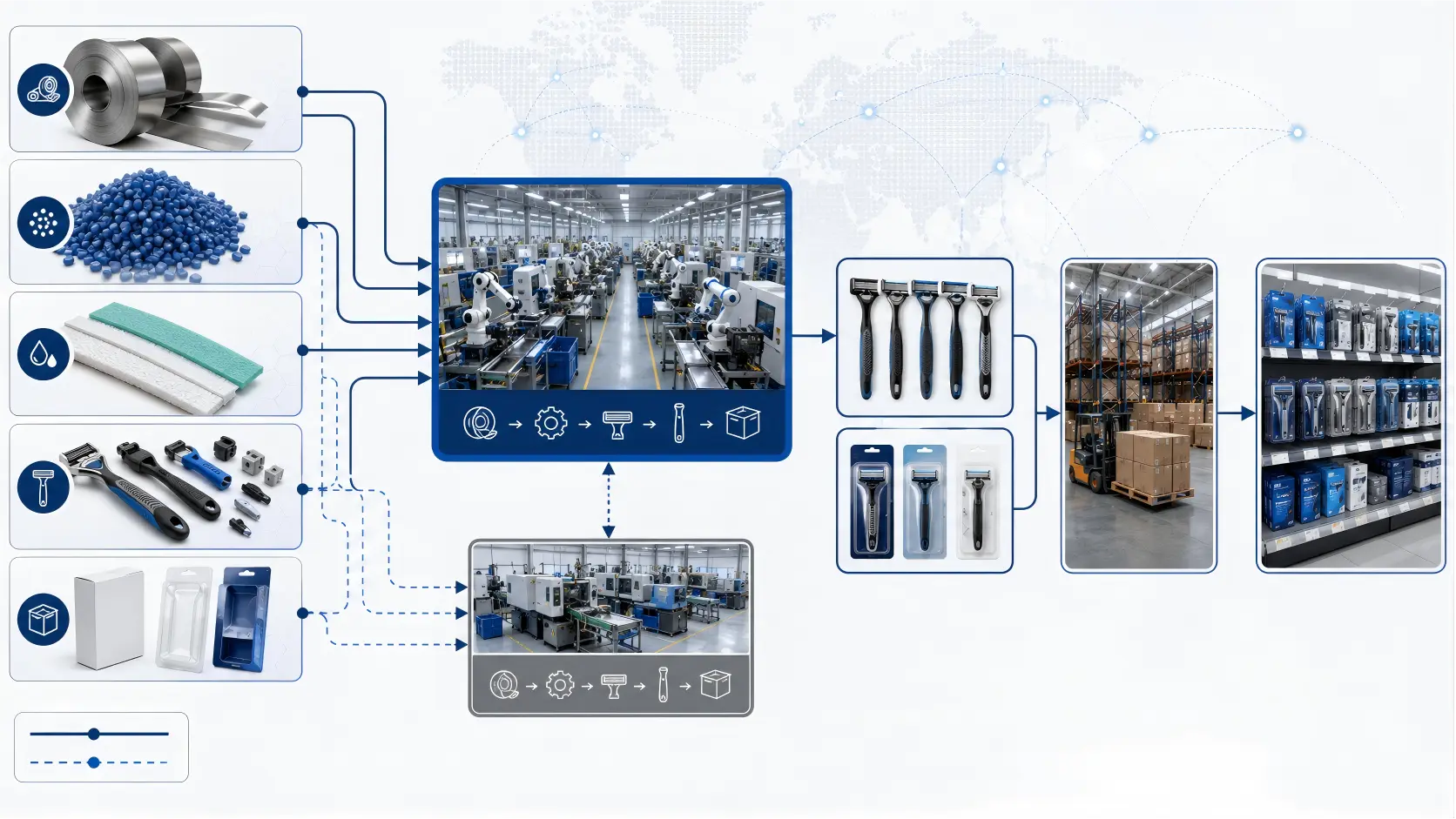
Single sourcing means deliberately placing a product or category with one Supplier, even when alternatives may exist. Sole sourcing is different: only one Manufacturer can currently provide the required patent, tooling, process, material, performance, or approval. Confusing the two can hide risk because a buyer may assume alternatives are unavailable without testing the market.
Dual sourcing normally uses two approved Suppliers for the same product, while multiple sourcing distributes demand across three or more. In Razor procurement, the model can also operate at different levels:
- One Manufacturer for the complete finished Razor;
- Different Suppliers for separate product families;
- Two factories producing the same approved SKU;
- One assembly Supplier using buyer-approved blade, resin, strip, and packaging sources;
- A lead factory plus a validated emergency backup.
Draw the actual supply chain map before choosing. Two finished-goods Suppliers may still depend on the same blade mill, mold shop, packaging printer, port, or sub-supplier. That structure looks diversified on a vendor list but retains a hidden common-mode failure.
2. When a Single Razor Supplier Creates the Most Value

A single Manufacturer is often commercially efficient during a new product launch, a low-to-medium volume program, or a technically integrated OEM system. Concentrating demand improves forecast visibility and can strengthen negotiation on unit price, tooling support, packaging MOQ, color batches, and production scheduling.
Operational Advantages
- One approved bill of materials (BOM) and golden sample;
- Fewer drawing revisions, artwork files, audits, and corrective-action channels;
- Consistent blade geometry, handle fit, lubrication strip, color, and packaging;
- Better utilization of molds, automation, and dedicated fixtures;
- Simpler lot traceability and complaint investigation.
Single sourcing is particularly suitable when a Customizable Razor uses proprietary head architecture, dedicated automation, or a newly developed mold that cannot be duplicated economically. An experienced ODM Supplier may also combine validated platforms with custom handles, colors, logos, and packaging, reducing development time.
The buyer must still avoid dependency without controls. Tooling ownership, capacity reservation, material substitution, price review, disaster recovery, and termination inventory should be documented. A strong relationship is valuable, but relationship confidence is not a substitute for business continuity planning.
3. Measure the Risks Hidden Inside Single Sourcing
The primary risk is not merely that the Supplier could fail. It is that the buyer cannot recover within the time customers will tolerate. Estimate time to recover (TTR): the period required to qualify materials, transfer or rebuild tooling, produce samples, pass testing, approve packaging, schedule production, inspect goods, and ship from an alternative Manufacturer.
Review the following concentration risks:
- Capacity concentration: one line, mold, shift, building, or utility dependency;
- Upstream concentration: one source for blade steel, coating, lubrication material, resin, or printed packaging;
- Geographic concentration: common port, transport lane, weather zone, or regulatory jurisdiction;
- Commercial lock-in: unpaid or non-transferable molds, restricted drawings, or proprietary connections;
- Financial exposure: large deposits, prepaid packaging, or Supplier instability;
- Quality concentration: one defect affecting the entire available inventory.
Use ISO 22301 business-continuity principles to ask how the Manufacturer prepares for, responds to, and recovers from disruption. Request evidence: backup equipment, spare molds, alternate materials, emergency contacts, data backups, insurance, recovery exercises, and documented escalation.
4. When Multiple Suppliers Improve Razor Supply Resilience

Multiple sourcing becomes valuable when annual volume can support duplicate qualification, service failure would stop an important retail program, or demand must be supplied across different regions. It can reduce dependence on one factory and provide evidence for price, lead-time, and performance benchmarking.
A second Supplier may provide:
- Surge capacity during promotion or seasonal demand;
- Alternative shipping routes and geographic risk diversification;
- Negotiating leverage based on verified, comparable quotations;
- Faster recovery from factory, tooling, quality, or labor disruption;
- Technology options for new blades, handles, materials, and packaging;
- A controlled source for regional or channel-specific Razor configurations.
However, the backup must receive real orders or periodic validation. A Manufacturer that produced one sample two years ago may no longer have the same materials, staff, equipment, certificate scope, or open capacity. The buyer should define a minimum sustaining volume, periodic pilot build, or annual requalification. Diversification works only when the alternative can meet the frozen OEM specification within the required recovery time.
5. Understand the Quality and Cost Burden of Multiple Suppliers
Adding Suppliers increases the number of process combinations that must be controlled. Two factories can follow the same drawing while producing different shave feel, cosmetic appearance, assembly force, or packaging durability. Tolerances interact across blade cartridges, handles, caps, lubrication strips, and printed materials.
Common multi-source problems include:
- Sample-to-sample variation hidden by broad written specifications;
- Different interpretations of critical, major, and minor defects;
- Color variation caused by resin, masterbatch, finish, or measurement differences;
- Different blade or coating sources affecting shave performance;
- Duplicated molds, fixtures, printing plates, testing, audits, and packaging MOQs;
- Fragmented demand reducing unit-price leverage and production priority;
- More complex traceability, complaints, recalls, and inventory segregation.
The buyer needs a central specification owner. Drawings, BOMs, golden samples, approved sub-suppliers, test methods, artwork, and change notices must use the same revision. Without that governance, multi-sourcing creates quality drift rather than resilience. Procurement savings should therefore be calculated after qualification, duplicated tooling, inspection, travel, inventory, and management costs.
6. Compare Both Models Using Total Sourcing Cost
Unit price alone cannot determine the better strategy. Compare total cost of ownership (TCO), including development, tooling, quality, logistics, inventory, disruption, and management effort. The following table summarizes typical trade-offs; actual results depend on Razor complexity, order volume, forecast accuracy, and Supplier capability.

| Decision factor | Single Supplier | Multiple Suppliers | Buyer question |
|---|---|---|---|
| Unit-price leverage | Usually stronger through concentrated volume | May weaken after volume fragmentation | Are price breaks based on annual or per-order volume? |
| Specification consistency | Easier to maintain | Requires central governance and correlation | Can both factories match the same golden sample? |
| Disruption exposure | Higher concentration risk | Lower only when backups are operational | What is the verified switching time? |
| Tooling and qualification | One primary investment | Duplicated or transferable investment | Who owns and can transfer the molds? |
| Audit and QC cost | Lower management complexity | Higher audit, testing, and inspection load | Does risk reduction justify recurring cost? |
| Innovation access | Deep collaboration with one Manufacturer | Broader technology and market comparison | How will confidential designs be protected? |
Model at least one disruption scenario. A slightly higher dual-source cost may be rational if a stockout would trigger retailer penalties or lost shelf space. Conversely, duplicating a low-volume custom mold may cost more than the realistic disruption exposure.
7. Make Two Suppliers Produce the Same Approved Razor
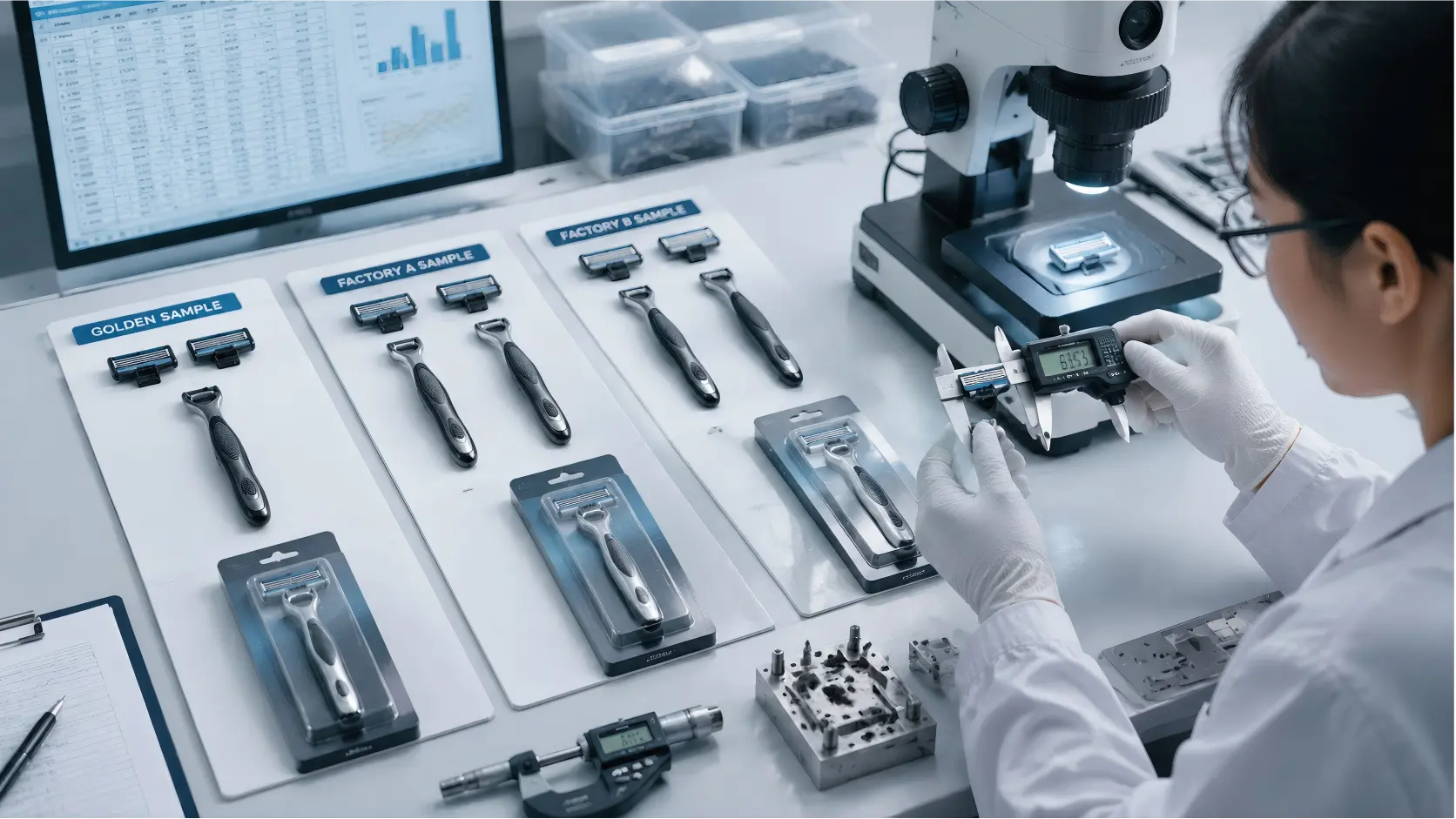
True dual sourcing requires technical interchangeability. The buyer must decide whether both Suppliers will manufacture an identical SKU or whether each will own a separate market, product family, or package. Identical production is more demanding because functional and cosmetic outputs must correlate.
Dual-Source Qualification Sequence
- Document freeze: approve the drawing, BOM, CTQs, test methods, artwork, defect library, and golden sample.
- Supplier qualification audit: verify process scope, capacity, quality system, sub-suppliers, traceability, and change control.
- First-article inspection: measure blade geometry, handle connection, dimensions, mass, finish, and packaging.
- Pilot-run gate: use intended tooling, materials, equipment, operators, and inspection methods.
- Correlation study: compare both Suppliers using the same samples, equipment principles, and acceptance criteria.
- Controlled market release: monitor complaints, returns, and lot performance before increasing allocation.
Certificates such as ISO 9001, ISO 14001, BSCI, GRS, or BRCGS must be verified by site, scope, issuer, and validity where applicable. Matching certificate logos do not prove matching Razor performance.
8. Choose a Capacity-Allocation Model That Keeps the Backup Alive
Order allocation should reflect risk and capability rather than splitting volume automatically. Equal allocation can reduce leverage with the stronger Manufacturer, while giving a backup no recurring orders can allow its readiness to decay.
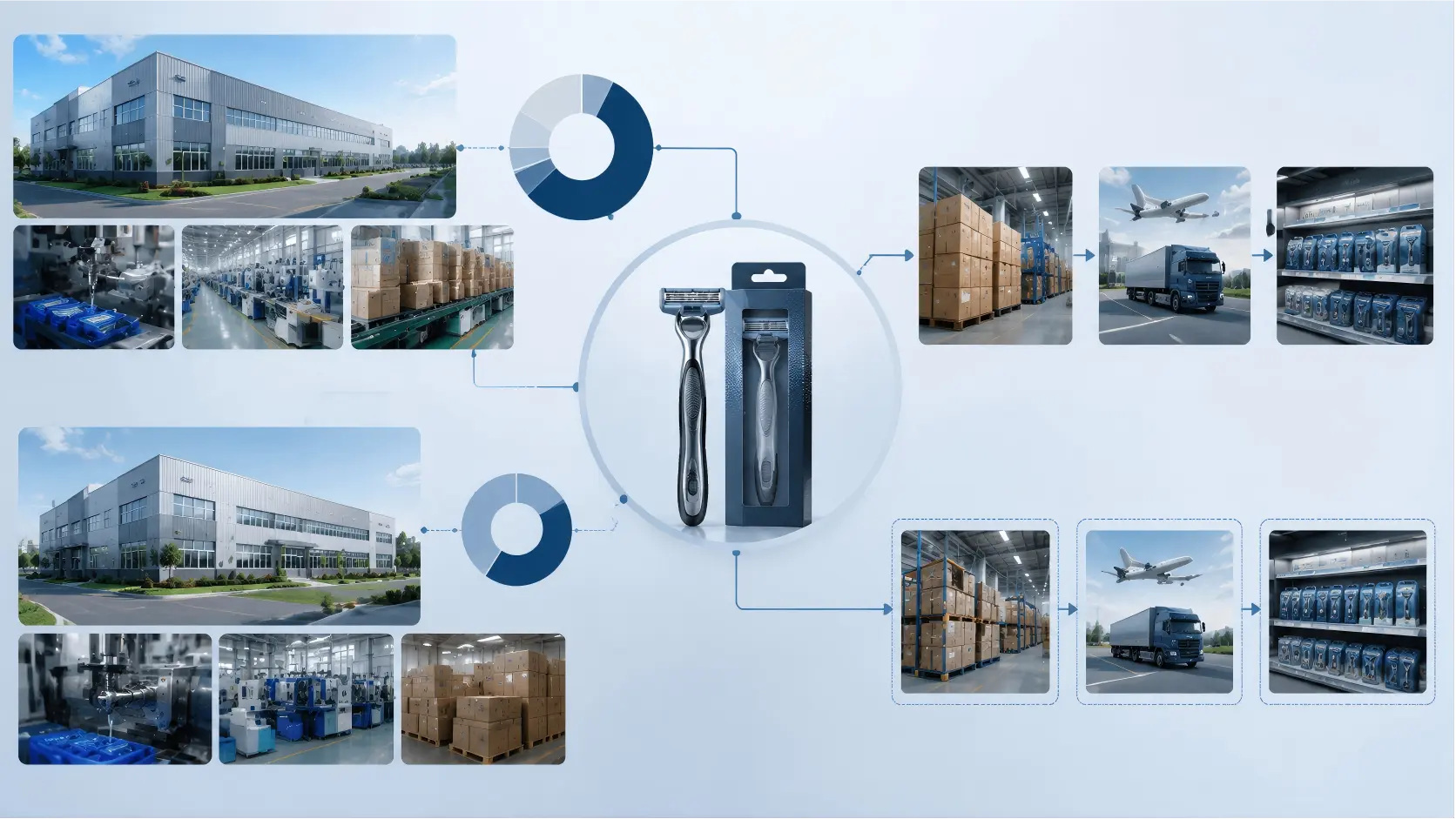
| Illustrative model | Allocation | Best fit | Main control |
|---|---|---|---|
| Focused single source | 100/0 | Low volume, proprietary tooling, early launch | Safety stock and documented recovery plan |
| Lead plus warm backup | 80/20 | Stable core SKU with meaningful disruption risk | Regular backup production and annual audit |
| Balanced dual source | 70/30 or 60/40 | High-volume retail program | Specification correlation and performance scorecard |
| Regional allocation | By destination | Different freight lanes or market packaging | Common functional standard across regions |
| Product-family split | By Razor category | Different Supplier technologies | Avoid shared critical upstream dependency |
These ratios are planning examples, not universal recommendations. Define an allocation review mechanism based on on-time delivery, defect rate, CAPA response, capacity, service, cost, and compliance. The backup should know the conditions for earning more volume, while the lead Supplier should not lose orders because of arbitrary diversification.
9. Protect Tooling, Data, and Commercial Freedom
Sourcing flexibility depends on who controls the product definition and production assets. A buyer cannot switch quickly if the drawings are incomplete, molds are inaccessible, software or fixtures belong to the Supplier, or packaging files are controlled by a third party.
The OEM or ODM agreement should define:
- Tooling ownership, identification, maintenance, useful life, storage, access, and transfer;
- Ownership and permitted use of industrial design, engineering drawings, artwork, and test data;
- Confidentiality and restrictions on unauthorized production;
- Engineering change notice (ECN) requirements for materials, processes, molds, and sub-suppliers;
- Termination inventory for custom resin, blades, components, and printed packaging;
- Continuity assistance, technical records, and transfer support after termination;
- Price-review mechanisms, forecast obligations, and capacity-reservation conditions.
For ODM platforms owned by the Manufacturer, complete transfer may not be commercially available. The buyer should understand that limitation before building a brand around the connection system. A separate backup may require a different but functionally equivalent Razor rather than an identical copy.
10. Use Supplier Scorecards and Audit Triggers, Not Intuition

A sourcing decision should be reviewed as evidence changes. Maintain a scorecard for quality, delivery, cost, capacity, development support, compliance, financial stability, and continuity. Record both leading indicators, such as overdue maintenance or slow corrective actions, and lagging indicators, such as defects and late shipments.
Recommended governance includes:
- Monthly delivery and quality review for active Suppliers;
- Quarterly capacity, forecast, and material-risk review;
- Annual Supplier requalification audit based on risk;
- Immediate escalation after a critical defect, unauthorized change, certificate lapse, or continuity event;
- Periodic verification of backup tooling and production readiness;
- Pre-shipment inspection using agreed defect classes and sampling plans.
ISO 2859-1:2026 provides AQL-indexed sampling schemes for lot-by-lot attribute inspection, including switching concepts based on quality history. The same defect definitions should apply across Manufacturers. Inspection data should feed allocation decisions, but acceptance sampling cannot repair an unstable process or replace Supplier development.
11. Apply a Hybrid Strategy to Razor Sourcing
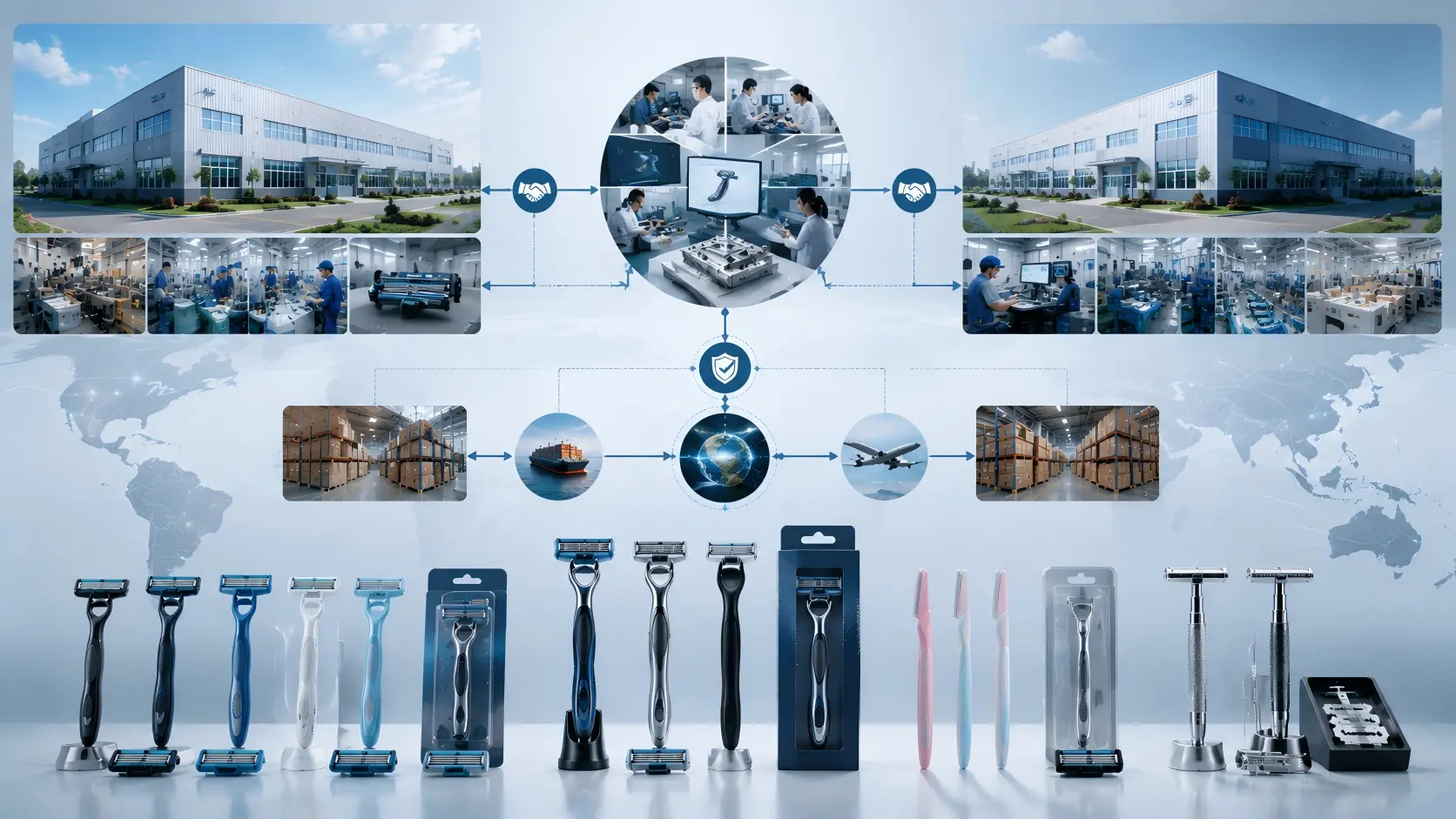
For many established men’s and women’s grooming programs, the practical answer is neither uncontrolled single sourcing nor automatic equal splitting. A hybrid sourcing strategy uses one lead Manufacturer for accountability, development, and most volume, while maintaining a qualified alternative for critical products or components.
Use the following decision logic:
- Classify each Razor SKU by revenue impact, substitution difficulty, tooling dependency, and customer penalty.
- Calculate time to recover and compare it with available safety stock.
- Identify common upstream dependencies that remain after adding another Supplier.
- Estimate the complete cost of duplicate qualification and sustaining readiness.
- Choose focused single sourcing, warm backup, dual sourcing, regional allocation, or product-family split.
- Reassess after major volume, design, market, capacity, or risk changes.
Haward Razor can operate as a consolidated Manufacturer for Customizable disposable, system, eyebrow, medical, and safety Razor programs. Buyers can simplify category management while still requiring transparent sub-supplier controls, business-continuity evidence, and agreed recovery measures.
Choose the Sourcing Structure That Can Survive a Real Disruption
The better model depends on product complexity, volume, switching time, tooling, and disruption impact. Send Haward Razor your product range, forecast, target markets, packaging, and continuity requirements to receive a structured OEM or ODM sourcing review and Customizable supply proposal.