

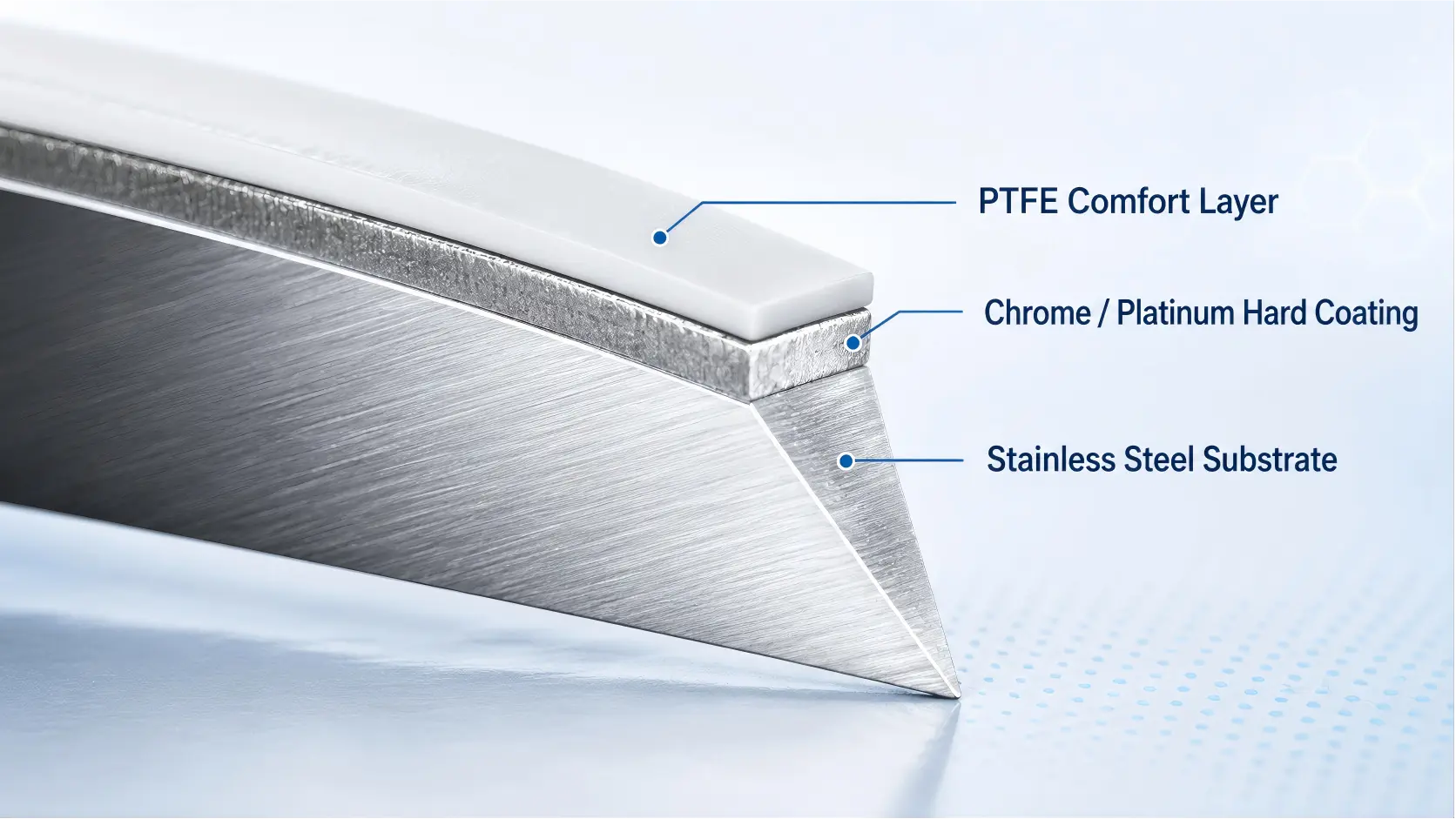
many private label buyers test two razor blades that look almost identical, yet one feels smooth for several shaves while the other becomes rough, noisy, or irritating too quickly. Agitation: when coating performance is unstable, customer complaints often appear as skin pulling, burning sensation, early dullness, or inconsistent comfort between batches. This affects repeat purchases and makes it harder for an OEM or ODM brand to build trust. Solution: blade coating should not be judged by one material name alone. A reliable selection must evaluate substrate steel, edge geometry, platinum/chrome hard coating, PTFE top coating, and batch-level quality control together.
The best razor blade coating system combines a strong stainless-steel edge, controlled hard coating such as platinum or chrome, and a low-friction PTFE comfort layer. At Haward Razor, we help OEM and ODM buyers select coating structures based on shaving comfort, durability, target price, and market positioning.
For buyers, coating is not a decoration. It is a functional system that influences glide, sharpness retention, corrosion resistance, comfort perception, and complaint risk. The sections below explain how each coating layer works, what parameters matter, and how a professional Manufacturer or Supplier should control coating performance.
How Razor Blade Coating Works as a Complete Edge System
1. Blade Coating Is Not One Layer; It Is a Multi-Layer Performance Structure
A manual razor blade usually starts with hardened stainless steel. The steel is ground and honed into a fine cutting edge. After that, coating is applied to improve the way the edge behaves during shaving. In practical manufacturing, the coating system may include a hard protective layer, a corrosion-resistant layer, and a low-friction comfort layer.
The hard layer helps protect the edge from micro-damage. The comfort layer reduces drag when the blade contacts hair and skin. If the hard layer is too weak, the blade may lose comfort quickly. If the PTFE layer is poorly bonded, the first shave may feel acceptable, but the glide can drop sharply after several uses.
This is why a professional OEM buyer should not ask only, “Is it platinum coated?” or “Is it PTFE coated?” The more important question is: what is the complete coating stack, and how is it controlled?

| Coating Element | Main Function | Buyer Concern | Common QC Focus |
|---|---|---|---|
| Platinum coating | Improves edge protection and premium positioning | Higher cost, consistency of layer coverage | Coating continuity, edge durability, shave-life testing |
| Chrome coating | Supports hardness and corrosion resistance | Balance between durability and smoothness | Corrosion testing, edge wear inspection |
| PTFE coating | Reduces friction and improves glide comfort | Bonding stability after repeated shaving | Friction check, first-shave feel, multi-shave comfort |
| Stainless steel substrate | Provides blade strength and cutting foundation | Sharpness retention and rust resistance | Hardness, edge geometry, incoming material control |
2. Platinum Coating: Premium Edge Protection and Long-Term Comfort
Platinum coating is often used in higher-positioned razor blades because it supports edge stability and premium product perception. In technical terms, platinum is not added to make the blade “more beautiful.” It is used as part of an engineered edge system that helps protect the sharpened cutting edge from early wear and micro-chipping.
For brand owners, the main value of platinum coating is not only the first shave. The real value appears after repeated use. A good coating can help the blade maintain a more stable cutting sensation. This can reduce complaints linked to tugging, rough glide, and fast comfort decline.
However, platinum coating also increases process cost. It is not always necessary for every product line. For entry-level disposable razors, buyers may prefer a more cost-controlled coating structure. For premium women’s razors, men’s system razors, or subscription shaving products, platinum coating can support a stronger value proposition.
A qualified Manufacturer should help the buyer compare target retail price, expected shave life, consumer skin sensitivity, and blade count before selecting platinum coating.
3. Chrome Coating: Hardness, Corrosion Resistance, and Cost Balance
Chrome coating is widely used because it offers a practical balance of hardness, corrosion resistance, and cost control. For many OEM and ODM razor programs, chrome is a dependable option when the buyer needs stable performance without moving into a premium coating budget.
Chrome can help protect the blade edge against moisture exposure, especially in bathrooms where razors are often stored in humid conditions. This matters because corrosion does not only affect appearance. Even small edge corrosion can increase shaving roughness and reduce perceived sharpness.
Chrome coating also supports edge durability. But the process must be controlled carefully. If the coating layer is uneven, the blade may show inconsistent cutting force. If the edge geometry is not well prepared before coating, chrome cannot correct the problem. Coating improves a good edge; it does not rescue a poor edge.
For a B2B buyer, chrome coating is suitable for mass-market disposable razors, private label supermarket razors, hotel amenity razors, and cost-sensitive retail packs. It can also be combined with PTFE to improve comfort performance.
4. PTFE Coating: The Layer Most Consumers Feel First
PTFE, or polytetrafluoroethylene, is the coating layer most directly connected with glide. It reduces friction between the blade edge, hair, and skin surface. When PTFE coating is well applied, the consumer often experiences a smoother first shave, less scraping sensation, and better comfort perception.
For marketing teams, PTFE is sometimes described simply as a “comfort coating.” Technically, the important point is friction reduction. Lower friction can help reduce the force needed for cutting hair. This may improve comfort, especially in women’s shaving, underarm shaving, leg shaving, and sensitive-skin applications.
But PTFE coating must be stable. If adhesion is weak, the glide layer may wear away too quickly. This creates a gap between first-use testing and real customer experience. A blade can feel good in a one-time sample test but perform poorly after several shaves.
Therefore, serious Supplier evaluation should include repeated shave simulation, coating adhesion review, cutting-force comparison, and consumer comfort feedback. PTFE should be selected as part of a full performance system, not as a single marketing claim.
| Performance Parameter | Cost-Control Blade Program | Premium Comfort Blade Program | Why It Matters |
|---|---|---|---|
| Initial cutting force | Controlled for basic sharpness | Lower and more stable target range | Affects first-shave smoothness and pulling sensation |
| Multi-shave comfort retention | Basic internal shave-life check | Stricter repeated-use comparison | Shows whether coating remains effective after several uses |
| Corrosion resistance | Standard humidity and storage checks | Enhanced corrosion and visual inspection | Reduces rust-related complaints and edge degradation |
| Friction/glide performance | PTFE layer for basic comfort | Optimized PTFE application and bonding | Improves skin feel and reduces harshness perception |
| Batch consistency | Routine AQL sampling | More detailed edge and coating control | Reduces variation between shipments |
5. Edge Geometry Still Decides the Foundation of Comfort

Coating is important, but it cannot replace correct edge geometry. A razor blade must first be sharpened properly. The edge angle, bevel uniformity, burr control, and polishing quality all affect how cleanly the blade cuts hair.
If the cutting edge is too aggressive, the blade may feel sharp but harsh. If the edge is too weak, the blade may pull hair and feel dull. If the bevel is inconsistent, the customer may experience different comfort levels from one cartridge to another.
This is why a technical marketing claim such as “platinum coated blade” or “PTFE coated blade” should always be supported by manufacturing control. A good coating works best on a stable edge. For OEM and ODM buyers, the technical conversation should include:
- Blade steel grade and hardness control
- Grinding and honing process stability
- Edge angle consistency
- Coating coverage and adhesion
- Final shaving comfort validation
At Haward Razor, coating selection is reviewed together with product structure, handle design, lubricating strip formula, blade count, and target usage scenario. This helps buyers avoid overpaying for unnecessary coating or under-specifying products for demanding markets.
6. Coating Selection by Product Type and Market Positioning
Not every razor needs the same coating structure. A hotel amenity razor, a supermarket private label razor, and a premium women’s system razor have different cost limits and consumer expectations.
For a hotel or travel razor, the buyer may focus on safe basic shaving, clean appearance, and competitive price. A chrome plus PTFE structure may be enough. For a supermarket private label disposable razor, comfort consistency and shelf-life stability become more important. For a premium system razor, platinum-enhanced coating may help support a higher-value positioning.
For women’s razors, comfort perception is especially important because shaving areas can include legs, underarms, and bikini-line-adjacent zones. A smoother PTFE layer, stable lubricating strip, and skin-friendly head design can matter as much as blade sharpness.
For men’s razors, beard density and hair thickness can create higher cutting resistance. In this case, edge durability, blade spacing, rinseability, and coating wear resistance should be evaluated together.
A Customizable program should define the coating system according to target user, retail price tier, expected shave count, pack format, and brand claim strategy.
7. Quality Control: What Buyers Should Ask Before Approving a Blade

Before approving production, buyers should ask more than whether a blade has platinum, chrome, or PTFE. They should ask how the Supplier verifies that the coating is stable and repeatable.
A practical QC system may include incoming steel inspection, edge sharpness control, coating process monitoring, visual edge inspection, corrosion resistance checks, AQL sampling, and shave performance comparison. For high-value programs, additional review may include microscopic inspection of edge condition and repeated-use evaluation.
For technical purchasing teams, the most important risk is not a single failed sample. The bigger risk is batch variation. A sample blade may pass internal evaluation, but mass production must remain consistent across orders. This is where experienced manufacturing control matters.
When working with Haward Razor as a Manufacturer and OEM/ODM Supplier, buyers can discuss different coating combinations, product structures, and packaging strategies before tooling and bulk production. This reduces rework, unclear claims, and late-stage product changes.
Conclusion: Choose Coating by Performance Target, Not by Name Alone
Platinum, chrome, and PTFE each solve different shaving problems. The right choice depends on comfort target, durability requirement, price tier, and brand positioning. Contact Haward Razor to build a Customizable OEM or ODM razor coating solution for your market.